

Marble Run Age Range: What Age Is Safe to Start?
Marble Run Building Blocks for Kids: Age Range and Developmental Guide
Marble run building blocks for kids are construction toys that combine tracks, connectors, ramps, and rolling marbles to help children explore cause-and-effect, creativity, and problem-solving. The right marble run age range depends on a child’s safety needs, motor skills, attention span, and ability to handle increasingly complex builds.
So, what age is a marble run for? Most marble runs are designed for children ages 3 and up, but simpler supervised versions can introduce younger toddlers to movement and construction concepts. Older children can continue using advanced sets to explore engineering, physics, and STEM principles.
Marble Run Building Blocks for Kids by Age: Complete 2026 Parent Guide
⏱ 8 min read — Choosing marble run building blocks for kids is easier when you understand how age, safety, and skill level work together. This guide explains the marble run age range, developmental benefits, safety considerations, and how children progress from simple marble track ideas to advanced engineering designs.
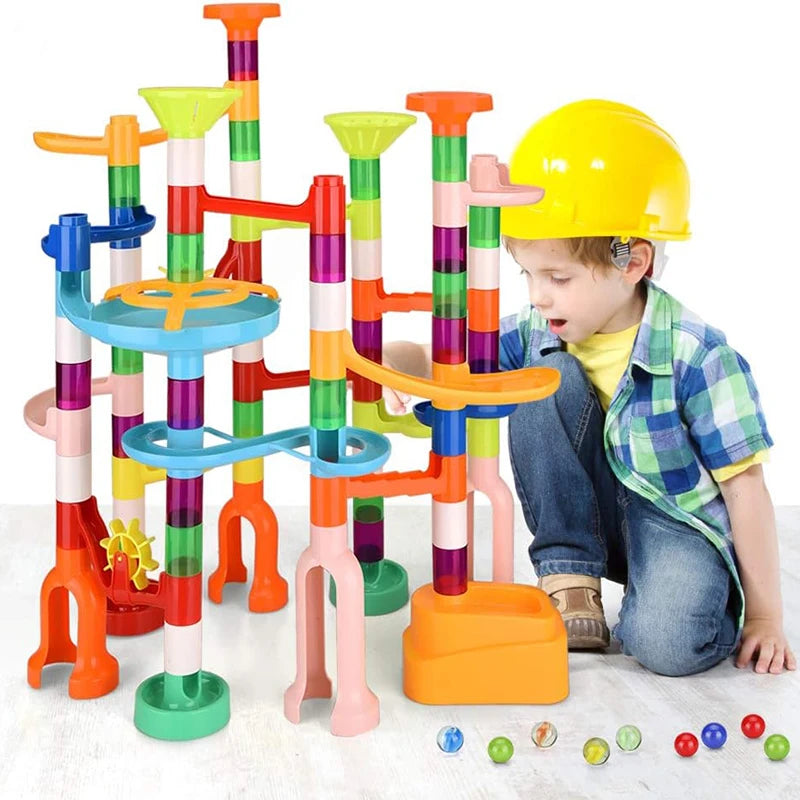
Marble run building blocks for kids spark creative marble track ideas through hands-on building
How Marble Runs Work and Why Age Matters
Marble runs work by allowing children to build pathways where marbles travel through ramps, curves, tunnels, and drops. Each component teaches children how structure, gravity, and movement interact.
Basic Marble Run Components and Construction Skills
A typical marble run set includes:
- Tracks and ramps: Create pathways that control marble speed and direction.
- Connectors: Help children build stable structures and understand balance.
- Funnels and curves: Introduce motion changes and prediction skills.
- Marbles: Provide instant feedback so children can test their designs.
As children grow, marble runs become more than a rolling toy. Younger children focus on placing pieces and observing movement, while older children create advanced marble track ideas that require planning, testing, and redesigning.
How Complexity Changes as Children Grow
| Age Stage | Typical Play Style | Main Skills Developed |
|---|---|---|
| 1–2 years | Simple observation and supervised exploration | Cause-and-effect, sensory learning |
| 3–4 years | Basic building and experimenting | Fine motor skills, creativity |
| 5–7 years | Independent construction and problem-solving | STEM thinking, planning, logic |
| 8+ years | Complex engineering challenges | Design thinking, advanced reasoning |
Marble Run Age Range Guide: Recommended Ages 1–2, 3–4, 5–7, and 8+
Ages 1–2: Sensory Exploration and Safety-Focused Play
For toddlers, marble runs should focus on observation, simple interaction, and adult-supervised exploration. At this stage, children are learning how actions create results.
- Large, easy-to-hold components support early coordination.
- Watching marbles move introduces basic cause-and-effect concepts.
- Simple designs prevent frustration and encourage curiosity.
Parents should always choose age-appropriate sets and supervise closely because traditional marble pieces may create choking risks for younger children.
Ages 3–4: Building Confidence and Creative Thinking
Ages 3–4 are often ideal for beginner marble run building blocks for kids. Children can start connecting pieces, creating simple paths, and learning through trial and error.
- Improves hand-eye coordination
- Encourages independent decision-making
- Builds patience through rebuilding attempts
- Supports imaginative construction play
These years are also when creative toys for 5 year olds and younger builders can help children develop confidence before moving to more challenging designs.
Ages 5–7: STEM Learning and Problem Solving
Children ages 5–7 begin experimenting with speed, height, and structure. Marble runs become hands-on STEM toys that introduce early engineering concepts.
Common challenges include:
- Creating longer marble tracks
- Testing different ramp angles
- Building stable towers
- Adjusting designs after failed attempts
At this stage, marble runs encourage the same curiosity found in the best construction toy experiences by combining creativity with logical thinking.
Ages 8+: Advanced Engineering and Complex Designs
Older children can explore advanced marble run systems that require planning and precision. Complex builds encourage children to think like designers by predicting outcomes before testing their ideas.
- Multi-level structures
- Advanced marble track ideas
- Collaborative engineering challenges
- Creative problem-solving projects
Marble Run Safety by Age: Choking Risks and Supervision Tips
Understanding marble run safety by age is essential before choosing a set. While marble runs provide valuable learning opportunities, small components require careful supervision for younger children.
Small Parts Safety for Toddlers
- Follow the manufacturer’s recommended age label.
- Avoid small marble pieces for children who still place objects in their mouths.
- Supervise younger children during every play session.
- Store marbles separately when toddlers are nearby.
Choosing Age-Appropriate Materials and Sizes
Younger children benefit from larger pieces that are easier to grip, while older children can safely handle smaller connectors and detailed construction elements. The best marble run set matches both age and ability level rather than simply choosing the largest option.
Wooden vs Plastic Marble Runs: Which Is Better by Age?
Wooden Marble Runs for Durability and Early Learning
Wooden marble runs are popular for younger children because they often provide sturdy pieces, simple designs, and a natural feel. They are useful for introducing basic construction concepts without overwhelming beginners.
- Strong and durable construction
- Simple layouts for early learners
- Good for guided parent-child play
Plastic Marble Run Sets for Creativity and Expansion
Plastic marble track systems often provide more flexibility for older children who enjoy experimenting with different configurations. Modular pieces allow children to create larger and more complex builds.
- More design possibilities
- Easy expansion with additional pieces
- Suitable for advanced marble track ideas
The right choice depends on your child’s age, play style, and interest level. Younger builders may prefer simplicity, while older children often enjoy expandable construction challenges.
Key Benefits of Marble Runs for Child Development
STEM Skills and Early Engineering Concepts
The benefits of marble runs go beyond entertainment. Children learn foundational STEM concepts by experimenting with movement, structure, and cause-and-effect relationships.
- Introduces gravity and motion concepts
- Strengthens spatial reasoning
- Develops planning skills
- Encourages testing and improvement
Creativity, Focus, and Problem Solving
Because marble runs can be rebuilt in countless ways, children practice flexible thinking and persistence. They learn that mistakes are part of the design process.
- Improves concentration during longer projects
- Supports creative thinking
- Builds confidence through successful solutions
- Encourages independent play
How to Choose the Right Marble Run Set
Choosing marble run building blocks for kids becomes easier when you evaluate safety, complexity, and long-term value.
| What to Consider | What to Look For |
|---|---|
| Age suitability | Recommended age range and safe piece size |
| Skill level | Beginner-friendly or advanced construction options |
| Durability | Strong materials and secure connectors |
| Replay value | Expandable pieces and multiple designs |
Explore product details here: /products/marble-run-building-blocks-set
Discover a hands-on construction toy that grows with your child’s creativity
FAQs
What age is a marble run suitable for?
Most marble runs are suitable for children ages 3 and up. Younger children may explore simplified versions with close adult supervision, while older children can enjoy advanced engineering builds.
Can a 2 year old play with a marble run?
A 2 year old can interact with certain marble run toys under direct supervision, especially larger-piece designs. Traditional marble sets with small parts may not be appropriate because of choking risks.
Are marble runs safe for young children?
Marble runs can be safe when children use age-appropriate sets and adults follow manufacturer safety recommendations. Supervision is especially important for toddlers.
What skills do children learn from marble runs?
Children develop fine motor skills, spatial reasoning, creativity, patience, problem-solving, and early engineering thinking through marble run construction.
Are wooden or plastic marble runs better?
Neither material is always better. Wooden marble runs are often ideal for simple, durable early learning, while plastic marble runs provide more flexibility for creative and advanced designs.
How can children progress to more advanced marble tracks?
Children can progress by starting with simple builds, experimenting with different layouts, and gradually adding complexity through longer tracks, multiple levels, and new construction challenges.
Where can I explore product details?
Visit /products/marble-run-building-blocks-set to review features and availability.





