

The Ultimate Guide to Toys for Fine Motor Skills: Skill-by-Skill Picks Backed by OT Experts
Toys for Fine Motor Skills: A Skill-by-Skill Buyer’s Guide for Parents & Teachers
If your child struggles to button a coat, hold a pencil comfortably, or use scissors without frustration, the issue may not be “clumsiness.” It may be a specific fine motor sub-skill that hasn’t fully developed yet. Fine motor skills are the small, precise movements of the hands and fingers that support independence, handwriting, and academic confidence.
Instead of choosing toys by age alone, this occupational-therapy-informed guide maps toys for fine motor skills to specific developmental sub-skills like pincer grasp, tripod grasp, bilateral coordination, in-hand manipulation, and hand strength. Whether you're a parent, teacher, or therapist, you’ll find comparison tables, pros and cons, and scenario-based recommendations for home, classroom, and therapy settings.
Quick-Start: Match Your Child’s Fine Motor Need in 60 Seconds
If Your Child Struggles With… → Focus On This Skill → Try These Toy Types
- Drops small items, uses whole hand to grab → Pincer Grasp → Peg boards, small sorting sets, Montessori bead transfer
- Awkward pencil grip, tires quickly when coloring → Tripod Grasp & Hand Strength → Short crayons, broken crayons, tracing boards, resistive putty
- Avoids two-handed tasks (holding paper + cutting) → Bilateral Coordination → Lacing cards, pop beads, construction toys
- Fumbles when rotating small objects in fingers → In-Hand Manipulation → Bolt boards, coin banks, mini puzzle cubes
- Presses too lightly or too hard when writing → Proprioceptive Feedback & Grip Control → Putty, squeeze tools, resistance building toys
Understanding Fine Motor Skills (Beyond “Improves Dexterity”)
Core Sub-Skills Explained
Pincer Grasp: The ability to pick up small objects using the thumb and index finger. Critical for feeding, picking up small toys, and later pencil control.
Tripod Grasp: The mature pencil grip using thumb, index, and middle finger. Essential for handwriting endurance and legibility.
Bilateral Coordination: Using both hands together in a coordinated way—one stabilizes, the other manipulates. Think cutting paper or building with blocks.
In-Hand Manipulation: Moving objects within one hand without using the other (rotating a coin, adjusting pencil position).
How Hand Strength and Proprioceptive Feedback Support Pre-Writing Skills
Strong intrinsic hand muscles allow children to sustain writing tasks without fatigue. Proprioceptive feedback—the body’s sense of force and pressure—helps regulate how hard a child presses when writing. Toys that provide resistance or require pushing, snapping, twisting, and squeezing support this sensory-motor loop.
How Occupational Therapy Strategies Inform Toy Selection
Occupational therapists often select materials that isolate a skill before integrating it into complex tasks. For example, bead transfer isolates pincer grasp; marble construction sets integrate grip, bilateral coordination, and visual-motor planning. If you want deeper developmental resources, explore our Baby Growth & Learning Tips for skill milestones and activity ideas.
The Fine Motor Skill Progression Roadmap (12 Months–8 Years)
Toddlers (1–3): Building Pincer Grasp & Bilateral Integration
- Large peg boards
- Chunky stacking rings
- Simple bead threading
Focus on controlled grasp and release. Avoid tiny marbles at this stage due to choking risk.
Preschool (3–5): Tripod Grasp, Scissor Skills & In-Hand Manipulation
- Short crayons and triangular pencils
- Lacing cards
- Child-safe scissors
Children begin refining precision and endurance.
Early Elementary (5–8): Hand Strength, Precision & STEM Manipulation Toys
Engineering-based building toys integrate multiple sub-skills while promoting logical thinking and patience.
Best Toys by Fine Motor Sub-Skill (OT-Backed Categories)
For Pincer Grasp Development
- Peg boards
- Sorting trays with tweezers
- Montessori bead transfer sets
Pros: Isolates precision grip; easy to scale difficulty.
Cons: Limited long-term complexity.
For Tripod Grasp & Pre-Writing Skills
- Short crayons
- Tracing boards
- Vertical easels
Pros: Direct handwriting support.
Cons: May feel repetitive without creativity element.
For Bilateral Coordination
- Pop beads
- Snap construction kits
- Cutting activity sets
Pros: Supports school-readiness tasks.
Cons: Requires supervision for younger children.
For In-Hand Manipulation & Dexterity
- Bolt boards
- Coin-drop toys
- Mini rotating puzzles
Pros: Excellent for finger isolation.
Cons: Smaller pieces increase safety considerations.
For Hand Strength & Proprioceptive Input
- Therapy putty
- Squeeze tools
- Resistance-based building systems
Pros: Builds endurance and grip control.
Cons: Can cause fatigue if overused.
Are STEM Manipulation Toys and Hands-On Engineering Sets Worth It?
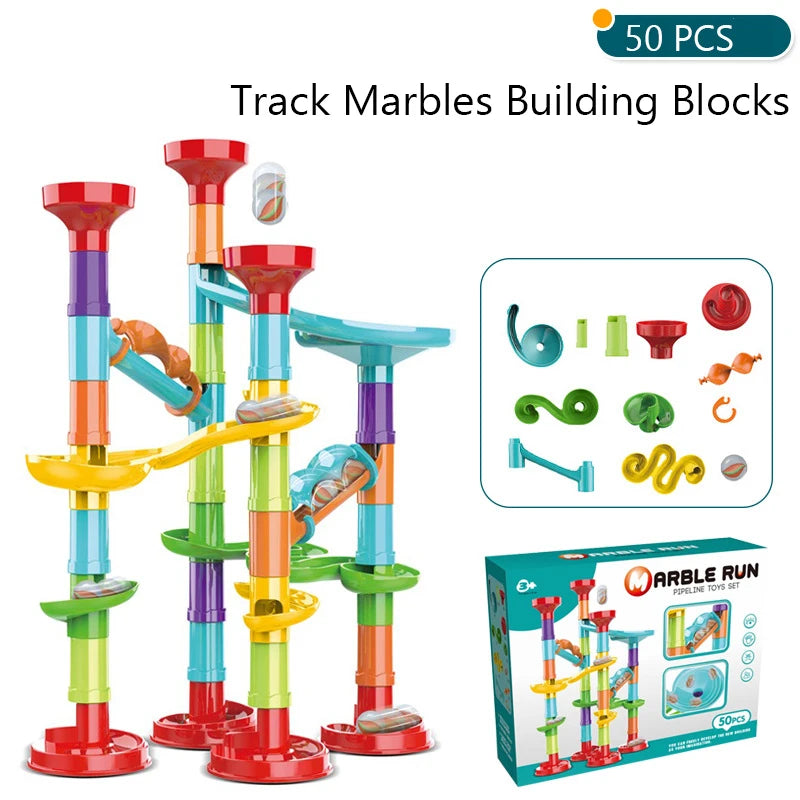
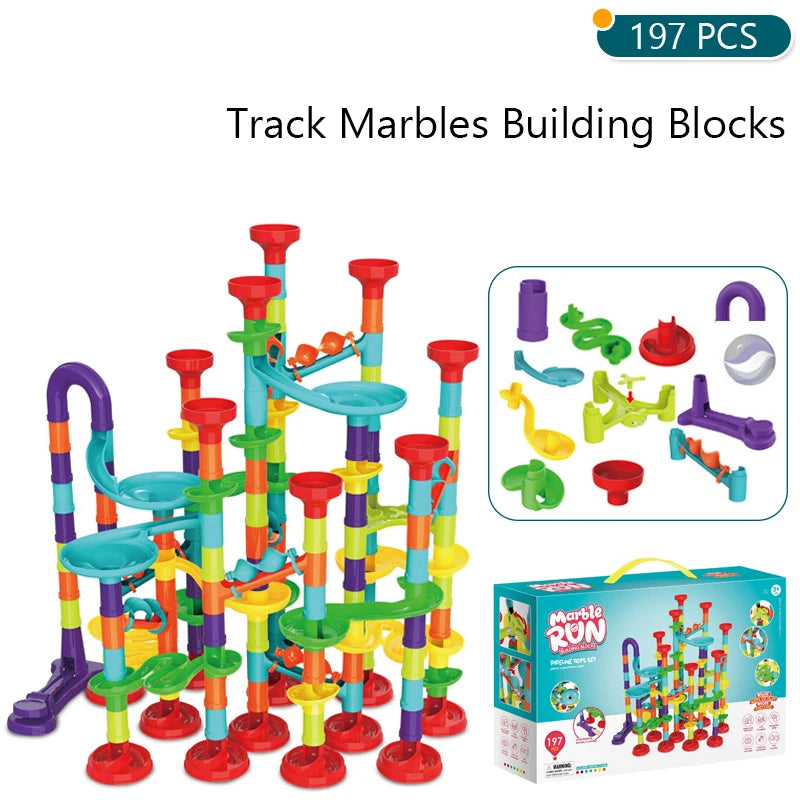
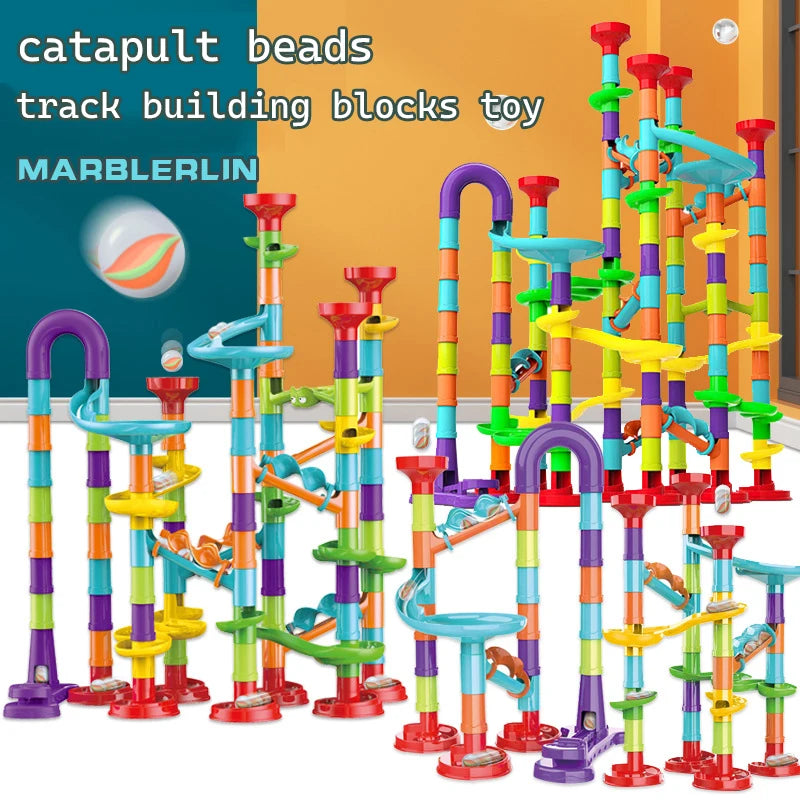
Yes—when chosen thoughtfully. The Marble Run Building Blocks Set – Creative STEM Fun integrates bilateral coordination, precision grip, and spatial reasoning.
Why it works for fine motor skills:
- Interlocking ABS pieces require controlled force
- Marble placement enhances pincer precision
- Track rebuilding promotes in-hand manipulation
Pros:
- High replay value
- Integrates multiple fine motor sub-skills
- Encourages patience and planning
Cons:
- Contains small marbles (6+ recommended)
- Requires flat surface and supervision
Montessori Materials vs. Traditional Construction Sets
Skill Isolation vs. Open-Ended Skill Integration
Montessori materials isolate and refine specific movements. Construction sets integrate motor skills with engineering logic. Both are valuable—choose isolation for remediation and integration for generalization.
Safety, Standards & Testing Transparency
Understanding ASTM Toy Safety Standards and CPSC Toy Regulations
Always look for ASTM compliance and CPSC labeling for choking hazard warnings. For safety-focused resources, visit our Health & Safety collection.
How We Tested
We evaluated grip fatigue after 15-minute builds, durability under repeated snapping, and ease of manipulation across age groups.
“Parents often focus on age labels, but fine motor progression is skill-specific. Choose toys that challenge the exact movement your child needs to strengthen.” — Pediatric Occupational Therapist
How to Use Fine Motor Toys at Home or in the Classroom
5-Minute Daily Fine Motor Routine (Home Version)
- 1 minute peg transfer
- 2 minutes tracing or coloring
- 2 minutes building challenge
Classroom Fine Motor Centers & Rotation Ideas
Create skill-based stations: grip station, cutting station, building station.
Adaptations for Sensory Sensitivities & Special Needs
- Offer textured grips
- Use larger components if tactile defensiveness exists
- Provide visual step-by-step guides
Explore more curated developmental tools in our Baby Growth & Learning collection.
Comparison Table: Fine Motor Skill → Best Toy Type → Age Range → Budget
| Skill | Best Toy Type | Age | Budget |
| Pincer Grasp | Peg Boards | 2–4 | Low |
| Tripod Grasp | Short Crayons | 3–6 | Low |
| Bilateral Coordination | Pop Beads | 3–6 | Medium |
| In-Hand Manipulation | Bolt Boards | 4–7 | Medium |
| Integrated Skills | Marble Run Building Blocks Set | 6+ | Medium |
For integrated STEM-based development, consider starting with a versatile building system that challenges multiple sub-skills at once.
FAQ
What are the best toys for fine motor skills by age and developmental stage?
Choose toys based on the specific sub-skill (pincer, tripod, bilateral coordination) rather than age alone.
How do I choose toys that promote fine motor skills like pincer grasp or tripod grasp?
Look for toys requiring precise thumb-index control or short writing tools that naturally guide correct finger placement.
What toys help improve hand strength and bilateral coordination?
Construction toys, putty, snap beads, and lacing sets build both strength and coordination.
Are STEM engineering sets good for developing fine motor skills?
Yes, when they require controlled assembly and small-part manipulation.
How can I use toys to improve fine motor skills at home or in the classroom?
Use short, consistent daily practice sessions and rotate skill focus weekly.
Conclusion
Selecting toys for fine motor skills by sub-skill progression—not just age—accelerates independence, handwriting readiness, and confidence. Whether isolating a pincer grasp or integrating multiple skills through engineering builds, intentional selection matters more than trends.
Explore developmentally aligned options in our Baby Growth & Learning collection to support your child’s next skill milestone.
Related Articles:





