

How to Trim Baby Nails Safely: Step-by-Step Guide for Parents
Does trimming a baby’s nails really have to be stressful?
Not necessarily. How to trim baby nails safely comes down to choosing a calm moment, using good lighting and a baby-sized tool, and keeping each cut or filing motion controlled. For newborn nail trimming, gently separate the fingertip from the nail, remove only the sharp edge, and stop if your baby moves suddenly.
Newborn fingernails are soft, thin, and surprisingly fast-growing, so regular nail care is part of normal baby grooming. Many parents worry about accidentally cutting delicate skin, but a simple routine can make trimming infant nails much more manageable. The safest approach is to choose a tool you can control comfortably, stabilize one finger at a time, and avoid trimming when your baby is actively moving.
In this guide, you’ll learn when to trim, how to hold your baby’s finger safely, how fingernails differ from toenails, which tools are easiest to use, what to do after an accidental nick, and when a nail problem should be checked by a healthcare professional.
⏱ 12 min read
how to trim baby nails / trimming newborn fingernails — See it in action
Why trimming newborn nails matters (and how it helps)
Regular nail care for newborns helps reduce the chance that sharp, uneven nail edges will scratch a baby’s face, eyes, or other delicate skin. Infant nails can grow quickly and may look as though they are attached very close to the fingertip, which is why careful positioning matters more than trying to remove as much nail as possible.
A good baby nail trimming guide should focus on keeping nails short enough to prevent sharp edges while preserving the skin underneath. Gentle, consistent care also helps parents establish a predictable grooming routine rather than waiting until nails become very long or ragged.
Key benefits at a glance
- Helps prevent scratches: Short, smooth nail edges can reduce accidental scratches to the cheeks, nose, and other areas.
- Protects delicate skin: Keeping nails neat may reduce irritation caused by sharp or broken edges.
- Supports healthy grooming habits: Regular checks make nail care easier as your baby grows.
- Makes everyday care easier: Smooth nails are less likely to catch on clothing, blankets, or other fabrics.
- Builds parental confidence: Repeating the same calm technique can make newborn nail trimming feel less intimidating.
When to trim baby nails
There is no single calendar day when every baby needs a trim. Check your baby’s nails regularly and trim them when the fingernails extend beyond the fingertip, develop a sharp edge, or begin catching on clothing. Newborn fingernails can grow quickly, so frequent checks are often more useful than following a rigid weekly schedule.
If you are wondering when you can begin trimming newborn fingernails , ask your pediatrician or follow the newborn-care guidance provided by your healthcare team, particularly during the earliest days after birth. Some parents find that filing is easier initially because it removes a small amount of nail at a time.
- While baby sleeps: A calm or sleeping baby may move less, making it easier to stabilize one finger.
- After feeding: Many babies are relaxed after a feed, although always choose a position that keeps your baby secure.
- After a bath: Nails may feel softer after bathing, which can make gentle filing easier. Make sure your baby is safely positioned and fully supported.
- When you notice sharp edges: You do not need to wait for a particular day of the week if a nail is long or jagged.
Fingernails and toenails need slightly different attention. Fingernails usually grow faster and can be shaped to follow the natural contour of the fingertip. Toenails should generally be trimmed straight across rather than deeply rounded at the corners, which can help avoid irritating the surrounding skin.
Best tools for gentle nail care
The best tool is the one that lets you see the nail clearly and maintain control without rushing. For newborns and young babies, parents commonly choose between a soft nail file, baby-sized clipper, rounded-tip scissors, or an electric nail trimmer.
- Soft emery board or baby nail file: A gentle option for smoothing sharp edges and gradually shortening very thin nails. It is especially useful when you are nervous about cutting too close.
- Baby nail clippers: Designed with a smaller cutting surface than adult clippers, making them easier to position on tiny nails.
- Rounded-tip baby nail scissors: Can provide precise control but require a steady hand and careful positioning.
- Mini LED nail clipper: Built-in illumination can improve visibility around tiny nail beds, which may make it easier to identify the nail edge before cutting.
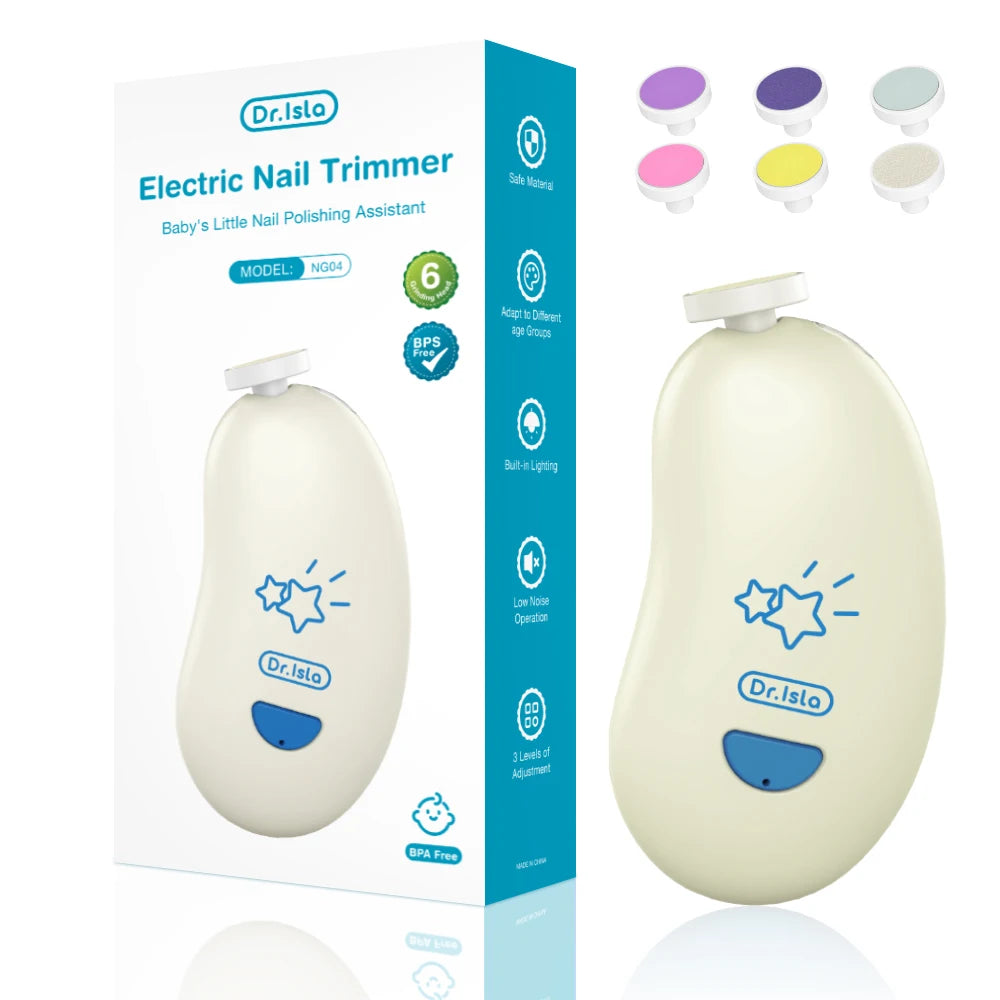
- Electric baby nail trimmer: Uses a gentle filing or buffering action instead of a cutting blade. This can be convenient for parents who are uncomfortable using manual clippers, particularly with a squirmy baby.
For the best way to cut infant fingernails , prioritize a tool that is specifically designed for babies, has an appropriately sized working surface, and allows you to stop immediately if your baby moves. Adult nail clippers are generally not a good substitute because their larger cutting surfaces can make positioning more difficult.
Explore specialized tools at Baby Nail Care Tools for options that match different comfort levels.
How to trim baby nails — step-by-step
How do I safely trim my baby's nails at home? Choose a calm, well-lit moment, support your baby securely, and work on one finger at a time. Push the fingertip pad gently away from the nail before trimming the exposed edge. Use small, controlled movements, avoid the skin and pink quick, and smooth any remaining sharp edges with a soft file.
Preparing before trimming
- Choose a calm location: Sit somewhere stable with enough light to see the nail and surrounding skin clearly.
- Gather everything first: Have your baby-sized clipper, file, electric trimmer if applicable, and a clean cloth within reach before beginning.
- Choose a calm moment: A sleepy period or relaxed time after feeding may work well. Never rush simply because you have started.
- Wash your hands: Clean hands and clean nail-care tools help keep the routine hygienic.
- Keep baby supported: Use a secure seated or supported position and never leave your baby unattended while trimming.
How to hold baby's finger safely
The most important hand-positioning technique is to separate the fingertip skin from the nail. Hold the baby’s finger securely between your thumb and index finger, then gently press the fingertip pad downward and away from the nail edge. This creates a small amount of space between the nail and skin so the cutting surface can contact the nail without pressing into the fingertip.
Work on one finger at a time. If your baby suddenly pulls away, stop rather than trying to finish the cut. Reposition the hand only when your baby is calm and your grip is secure.
Step-by-step fingernail trimming
- Stabilize the hand: Support your baby's wrist and hand so the finger you are working on does not move unexpectedly.
- Separate skin from nail: Gently push the fingertip pad away from the nail using your thumb.
- Identify the free edge: Look for the portion of nail extending beyond the fingertip. Do not try to cut deeply into the nail bed.
- Trim only the sharp edge: Use small, controlled cuts rather than one large snip. Avoid cutting into the pink area or very close to the skin.
- Follow the natural shape: For fingernails, lightly follow the natural contour without aggressively rounding the corners.
- Check every edge: Run your eyes over the nail before moving to the next finger.
- File rough spots: Use a soft file to smooth any remaining sharp or jagged edge.
- Pause when needed: It is completely fine to trim only a few nails during one session and finish later.
How to trim baby toenails correctly
Toenails should be handled more conservatively than fingernails. Support the toe in the same secure way, keep the cutting tool perpendicular enough to make a controlled trim, and generally trim the nail straight across rather than cutting deeply into the corners. Do not dig into the skin at the sides of the toenail or attempt to remove a corner simply because it looks uneven.
If a toenail is already red, swollen, painful-looking, or appears to be growing into the surrounding skin, stop home trimming and see the section on when to ask for help below.
Quick visual checklist
- Good lighting or a mini LED nail clipper ✔
- Baby securely supported ✔
- Fingertip pad gently pushed away from nail ✔
- One finger at a time ✔
- Small, controlled trim only ✔
- Fingernails follow their natural contour ✔
- Toenails trimmed straight across ✔
- Rough edges smoothed with a soft file ✔
Safety-first tips and common mistakes to avoid
To safely trim baby nails , control and visibility matter more than speed. A short pause is safer than trying to complete a nail while your baby is moving.
- Do not cut too short: Remove only the excess nail extending beyond the fingertip. Cutting into the nail bed or surrounding skin can cause pain and bleeding.
- Do not trim during active movement: If your baby pulls, kicks, or suddenly turns, stop and wait for a calmer moment.
- Do not rely on poor lighting: Good visibility makes it easier to distinguish the nail from delicate skin.
- Do not use adult clippers: A larger cutting surface can be harder to control on tiny infant nails.
- Do not force a full session: Trimming a few nails safely is better than rushing through all ten.
- Keep tools clean: Follow the manufacturer's cleaning instructions and allow reusable tools to dry fully before storing.
- Do not share nail-care tools without cleaning them: Keeping baby grooming tools clean helps maintain good hygiene.
- Use electric trimmers gently: Choose a baby-appropriate head and the manufacturer's recommended setting. Do not press the sanding surface hard against the nail.
| Step | What to do |
|---|---|
| 1 | Stop trimming and stay calm. Gently clean the area with clean water. |
| 2 | Apply gentle, continuous pressure with a clean cloth or gauze until the bleeding stops. |
| 3 | If bleeding does not stop with gentle pressure, the cut is significant, or you are concerned about the wound, contact your pediatrician or seek appropriate medical care. |
Compare methods: clipping, filing, and electric trimming
There is no single universally best method for every baby. The right choice depends on nail thickness, your visibility, your hand control, and how much your baby moves during grooming.
| Method | Best for | Pros | Considerations |
|---|---|---|---|
| Soft nail file | Very thin or ragged newborn nails | Gradual, controlled removal; useful for smoothing sharp edges | Takes longer and requires gentle filing |
| Baby clippers | Parents comfortable with controlled cutting | Fast and convenient | Requires precise positioning to avoid skin |
| Mini LED nail clipper | Parents who want improved visibility | Built-in light can make tiny nail edges easier to see | Still requires a steady grip and careful positioning |
| Electric nail trimmer | Parents concerned about clipping or babies who move frequently | Gradual filing action; can be easier for some first-time parents | Requires the correct baby-safe head, gentle pressure, and battery or charging |
Pros / Cons quick list
- Soft file: Gentle and gradual, but slower.
- Baby clippers: Fast and practical, but require precise finger positioning.
- Mini LED nail clipper: Improves visibility, but does not replace careful technique.
- Electric trimmer: Gradual filing can feel reassuring, but parents still need to use the correct head and light pressure.
For a newborn, a soft file or appropriately designed electric trimmer may appeal to parents who want gradual nail removal. As babies grow and nails become easier to see and control, some parents prefer baby clippers for faster trimming.
trimming newborn fingernails / clipping infant nails — See the technique in action
Quick trimming checklist
Use this baby nail trimming guide before each session to reduce rushing and keep the process organized.
- Prepare: Wash your hands and clean the nail-care tool according to its instructions.
- Set up: Choose a stable, well-lit place and keep a clean cloth nearby.
- Position: Support your baby securely and work on one finger or toe at a time.
- Separate: Gently push the fingertip pad away from the nail before trimming.
- Trim: Remove only the excess sharp edge using small, controlled movements.
- Shape: Follow the natural contour of fingernails and trim toenails straight across.
- Smooth: Use a soft file to remove rough edges.
- Stop if needed: If baby becomes restless, pause and finish later.
- Clean up: Dispose of nail fragments, clean reusable tools as directed, and store them safely.
Real-life scenarios & troubleshooting
Scenario 1: Baby wiggles constantly
Do not try to hold a moving finger against a cutting tool. Pause and wait for a calmer period, such as a sleepy window. You can also trim one nail at a time across several short sessions instead of trying to complete the entire hand at once. A second adult can help provide gentle support and distraction, but should never restrain the baby forcefully.
Scenario 2: Baby cries every time
First, check whether the timing or tool is causing the problem. Try a quieter environment, shorten the session, or switch from clipping to gentle filing. If you use an electric trimmer, let your baby hear the device before bringing it near the hand and use only a baby-appropriate head and setting.
Scenario 3: Nails are very thin or ragged
Very thin newborn nails may not need aggressive trimming. A soft file can gradually smooth sharp or uneven edges. Avoid repeatedly clipping the same area because the goal is simply to remove the part that can scratch or snag.
Scenario 4: What to do if you accidentally cut skin
Stop immediately and apply gentle pressure with a clean cloth or gauze. Keep pressure steady rather than repeatedly lifting the cloth to check. Once bleeding has stopped, keep the area clean and observe it. If bleeding continues, the wound appears significant, or you notice increasing redness, swelling, warmth, drainage, or other signs of infection, contact your pediatrician or seek medical care.
Using an electric baby nail trimmer safely
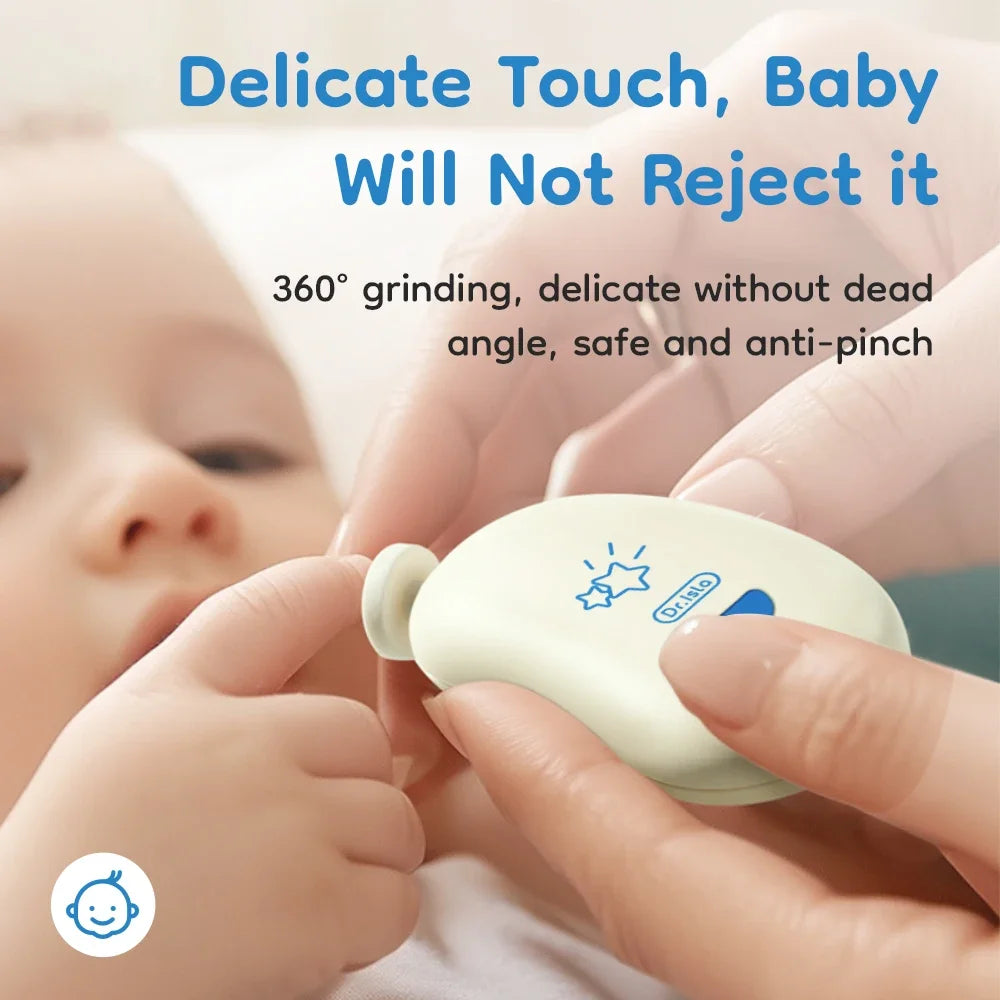
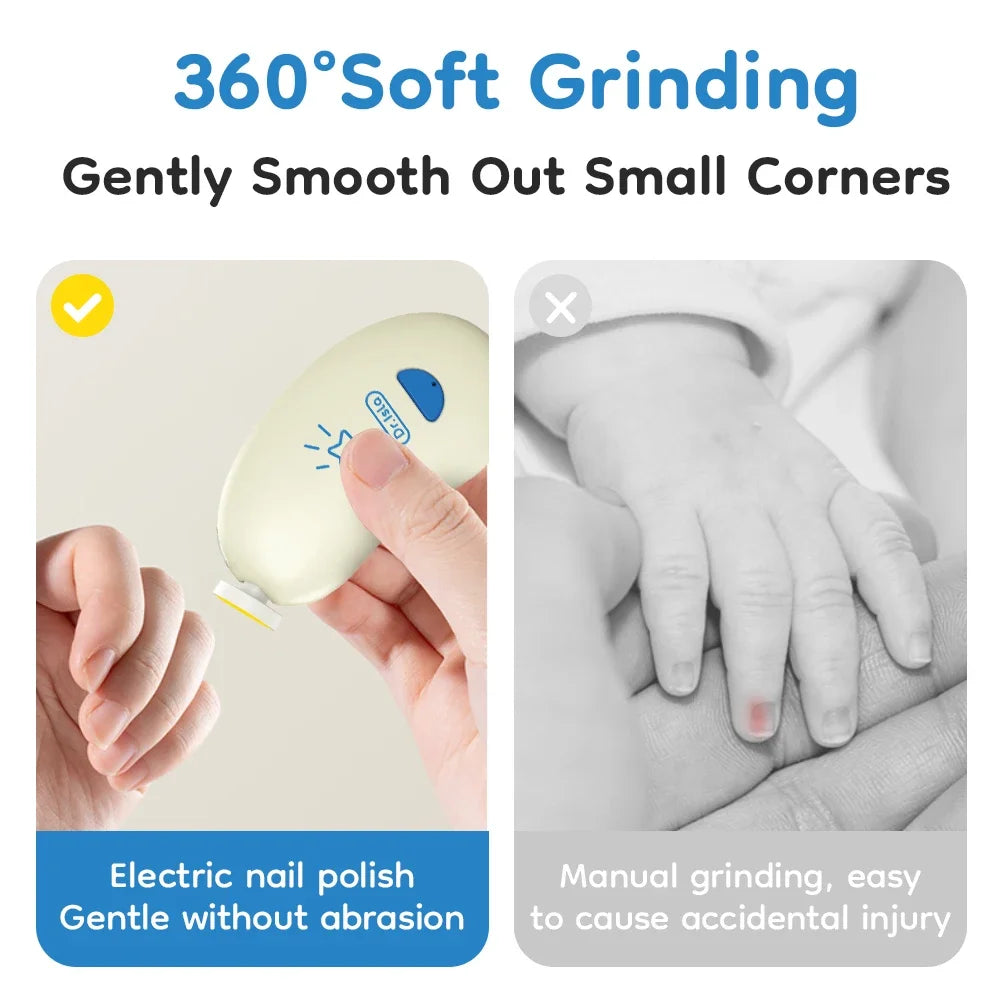
An electric baby nail trimmer can be a useful alternative to manual clipping because it gradually files the nail instead of making a single cutting motion. This can give some parents greater control, particularly when caring for a squirmy infant. However, an electric device is not automatically safer simply because it is powered: the correct baby-safe head, gentle pressure, visibility, and careful positioning still matter.
If you’re considering an electric option, the Electric Baby Nail Trimmer Set is designed for baby nail care and can be used according to the product's included instructions and age recommendations.
Step-by-step with an electric trimmer
- Check the device: Make sure the trimmer is charged or has working batteries and that the appropriate baby head is securely attached.
- Choose the correct setting: Start with the gentlest setting recommended by the manufacturer for your baby's age.
- Position the finger: Support the hand and gently move the fingertip pad away from the nail.
- Use light contact: Bring the filing surface to the nail gently. Do not press hard or hold it in one place for an extended period.
- File gradually: Use brief, controlled passes over the exposed nail edge and check the length frequently.
- Stop before over-trimming: You only need to remove the sharp or excess portion.
- Check the edge: Inspect the nail and use a soft manual file if a small rough edge remains.
Tips for first-timers using an electric trimmer
- Turn the device on away from your baby first so the sound is not unexpected.
- Use good lighting even if the device includes an LED light.
- Keep your baby securely supported and work on one nail at a time.
- Use minimal pressure; let the filing head do the work.
- Follow the manufacturer's age, head, speed, cleaning, and usage instructions.
- Stop immediately if your baby moves unexpectedly.
How this approach builds long-term confidence
Confidence with newborn nail trimming comes from repeating a safe process rather than trying to become faster. Keep the same basic sequence each time: prepare the tools, choose a calm moment, secure the hand, separate the skin from the nail, remove only the excess edge, and smooth the result.
As your baby grows, you can adjust the routine to suit changing nail thickness, movement, and temperament. A predictable grooming routine can also make other newborn-care tasks feel more manageable. The goal is not perfect nails; it is safe, comfortable, consistent nail care for newborns .
Common parent concerns answered
- “Will I hurt my baby?” Careful positioning and small, controlled movements reduce the chance of accidental skin contact. If you are uncomfortable using clippers, a soft file may provide a more gradual approach.
- “Do I need to finish all the nails at once?” No. If your baby becomes restless, stop and continue later.
- “What if I cannot see the nail clearly?” Improve the lighting or consider a baby tool with integrated illumination, such as a mini LED nail clipper.
- “Can filing be enough?” Yes. Filing can be useful for maintaining short, smooth edges, particularly when nails are thin.
When to Avoid Trimming and Ask for Help
Most routine nail care can be handled at home, but not every nail problem should be treated as a grooming issue. Pause trimming and seek professional advice if the skin around a nail becomes increasingly red, swollen, warm, painful, or develops drainage. These can be signs of irritation or infection that may need assessment.
You should also ask your pediatrician or another qualified healthcare professional for guidance if your baby has a significant cut, bleeding that does not stop with gentle pressure, a nail that appears badly injured, or a persistent change in nail color or shape that concerns you.
- Stop trimming: If the surrounding skin is inflamed, painful, or visibly injured.
- Seek advice: If you suspect an ingrown toenail or the nail repeatedly grows into the surrounding skin.
- Get medical help: If bleeding is persistent or the injury appears more than a minor superficial nick.
- Ask before proceeding: If your baby has an unusual nail condition or you are unsure how to manage it safely.
Mini-FAQ
-
Can you trim a newborn's nails from birth?
Newborn nails can be very soft and may appear attached closely to the fingertip. Follow the newborn-care guidance from your healthcare team about when and how to begin. When nail care is appropriate, use a baby-specific file or other suitable tool and avoid cutting the surrounding skin.
-
What is the safest way to cut infant fingernails?
Choose a calm, well-lit moment, support the baby securely, and hold one finger at a time. Gently push the fingertip pad away from the nail, then remove only the exposed sharp edge with small, controlled movements. Finish by smoothing any rough edge with a soft file.
-
How often should I trim my baby's nails?
Check them regularly rather than following a strict schedule. Fingernails can grow quickly, so trim when they extend beyond the fingertip, become sharp, or start catching on clothing. Toenails generally need less frequent attention.
-
Is an electric baby nail trimmer safe for newborns?
An electric baby nail trimmer can be suitable when it is specifically designed for babies and used according to the manufacturer's instructions. Use the appropriate head and gentle setting, avoid pressing hard, maintain good visibility, and stop if your baby moves unexpectedly.
-
What should I do if I accidentally cut my baby's skin?
Stop trimming, gently clean the area with clean water, and apply steady gentle pressure with a clean cloth or gauze until bleeding stops. Contact your pediatrician or seek medical care if bleeding persists, the injury is significant, or you notice concerning changes afterward.
-
Should baby toenails be cut differently from fingernails?
Yes. Fingernails can generally follow the natural contour of the fingertip, while toenails are usually best trimmed straight across. Avoid cutting deeply into the corners or digging into the skin around a toenail.
-
Is biting a baby's nails safe?
No. Biting or tearing a baby's nails is not a recommended nail-care method because it can create uneven edges and introduce germs from the adult's mouth. Use a clean baby nail file, baby clipper, or appropriately designed electric trimmer instead.
clipping infant nails / nail care for newborns — See the gentle nail-care technique
For more baby grooming resources, explore Baby Nail Care Tools and related baby-care guidance in Baby Care Essentials . A consistent routine, appropriate tools, good lighting, and careful hand positioning are the essentials for safely managing newborn nails at home.
Need more help choosing a tool or building a grooming routine? Explore gentle options at Baby Nail Care Tools or review safety resources in Health & Safety .
Related Articles:
- Portable Baby Nail Trimmer Tips: On-the-Go Nail Care Made Simple
- LED Baby Nail Clipper Usage: Tips for Safe and Easy Trimming
- Gentle Baby Nail Trimming Method: Tools and Techniques That Work
- Quiet Baby Nail Trimmer Guide: Calm Nail Care for Newborns
Pillar Articles:





