

Montessori Sensorial Materials Explained for Parents & Teachers
Montessori Materials Sensorial: A Complete Guide to the Sensorial Curriculum
Children begin learning through their senses long before they can read, write, or understand abstract concepts. Sight, touch, sound, smell, taste, and movement help young children build a mental map of the world around them. The Montessori approach recognizes this natural process and provides carefully designed Montessori sensorial materials that help children refine perception, organize information, and develop independent thinking.
In the Montessori curriculum, sensorial materials in Montessori classrooms are not simply toys or entertainment. Each material isolates a specific sensory quality—such as size, color, texture, sound, weight, or shape—so children can compare, classify, and understand differences through hands-on exploration.
This complete guide explains what Montessori sensorial materials are, why the Sensorial area is essential, how materials support cognitive development, the complete sensorial material list, presentation methods, age progression, and how parents can create meaningful Montessori sensory experiences at home.
What Are Montessori Sensorial Materials?
Definition of Montessori Sensorial Materials
Montessori sensorial materials are specially designed educational tools that help children refine their ability to observe, compare, classify, and understand sensory information. Instead of presenting several concepts at once, each material focuses on one specific quality, allowing children to isolate and master a single skill.
Examples include materials that teach:
- Differences in size through the Pink Tower
- Variations in dimension through the Brown Stair
- Color recognition through Color Tablets
- Texture awareness through Fabric Boxes
- Sound discrimination through Sound Cylinders
- Weight comparison through Baric Tablets
The goal is not memorizing information but developing the child’s ability to notice details and make logical connections independently.
The Purpose of the Sensorial Area in Montessori Education
The Sensorial area is one of the core areas of the Montessori classroom, following Practical Life activities and preparing children for more advanced academic learning. Through repeated work with sensorial materials, children strengthen concentration, coordination, independence, and problem-solving skills.
The sensorial curriculum helps children:
- Recognize patterns and relationships
- Develop classification skills
- Build accurate observation habits
- Improve focus and attention span
- Move from concrete experiences toward abstract thinking
These abilities become the foundation for later work with Montessori Mathematics materials , language activities, and scientific exploration.
Maria Montessori Theory on Sensory Play
Dr. Maria Montessori believed that children construct intelligence through interaction with their environment. Her observations showed that young children naturally seek sensory experiences because their minds are actively organizing information from the world around them.
The Montessori theory on sensory play is based on three important principles:
- Isolation of difficulty: Each material highlights one learning challenge so children can focus clearly.
- Control of error: Materials allow children to recognize and correct mistakes independently.
- Self-directed repetition: Children repeat activities until they achieve confidence and mastery.
Why Sensorial Learning Matters Before Academic Skills
Before children work with numbers, letters, and scientific concepts, they need the ability to observe accurately and organize information. Sensorial activities develop the mental processes required for later academic success.
For example, recognizing that one object is larger than another prepares children for measurement concepts. Matching similar sounds strengthens auditory awareness needed for language development. Comparing textures improves tactile sensitivity that supports handwriting preparation.
Sensitive Periods and Readiness for Sensorial Work
Typical Age Range
Most children begin exploring Montessori sensorial materials between approximately ages 2.5 and 6 years old. This period corresponds with a strong developmental interest in order, classification, movement, and sensory exploration.
However, Montessori education follows the child rather than enforcing a strict timeline. Some children may begin earlier, while others need more time to develop concentration and coordination.
Signs a Child Is Ready
Children may be ready for sensorial Montessori activities when they show interest in:
- Sorting objects by color, size, or shape
- Repeating simple activities independently
- Organizing toys or household items
- Exploring textures, sounds, and movement
- Completing tasks that require concentration
Following the Child's Interests
Montessori sensorial education respects individual development. A child who enjoys arranging objects may be ready for visual materials, while another child who loves music and sounds may naturally begin with auditory activities.
The Montessori approach encourages adults to observe readiness and introduce materials when the child shows genuine interest.
Developmental Goals of Montessori Sensorial Materials
Refining the Five Senses
Sensorial Montessori materials help children develop increasingly precise sensory discrimination. Children learn to identify subtle differences instead of simply recognizing basic characteristics.
- Visual discrimination of size, shape, and color
- Tactile awareness of texture and temperature
- Auditory discrimination of pitch and volume
- Recognition of scents and tastes
- Stereognostic understanding through touch
Developing Observation and Classification
Many sensorial activities require children to compare, match, sort, and sequence objects. These actions strengthen executive function skills such as attention control, memory, decision-making, and logical organization.
When a child arranges blocks from largest to smallest, they are practicing early mathematical reasoning and developing the ability to recognize relationships between objects.
Indirect Preparation for Mathematics
Montessori sensorial materials prepare children for mathematics by introducing concepts of order, sequence, measurement, and quantity through physical experiences.
Examples include:
- The Pink Tower introducing dimension and proportional relationships
- The Brown Stair preparing children for comparison and measurement
- Number-related sensorial activities supporting mathematical patterns
Indirect Preparation for Language
Sensorial experiences expand vocabulary because children connect words with real observations. Terms such as rough, smooth, heavy, light, wide, narrow, large, and small become meaningful through direct experience.
This process supports expressive language development and prepares children for more advanced reading and communication skills.
Categories of Sensorial Materials in the Montessori Classroom
Visual Materials
Visual materials help children recognize differences in dimension, color, and form.
Pink Tower
The Pink Tower contains ten cubes that gradually decrease in size from 10 centimeters to 1 centimeter. Children stack the cubes from largest to smallest, developing visual discrimination, coordination, and spatial awareness.
Age Range: 3–4 years
Brown Stair
The Brown Stair includes ten rectangular prisms with equal length but different widths and heights. Children arrange the prisms from thickest to thinnest, strengthening dimensional comparison.
Color Tablets
Color Tablets introduce children to color recognition, matching, and grading. Advanced sets include different shades that help children identify subtle variations.
Tactile Materials
Fabric Box
The Fabric Box contains pairs of materials with different textures, such as cotton, silk, and wool. Children use touch to match identical fabrics, improving tactile awareness.
Touch Boards
Touch Boards allow children to compare rough and smooth surfaces while refining sensitivity in their fingertips.
Auditory Materials
Sound Cylinders
Sound Cylinders contain objects that create different sounds when shaken. Children match pairs by listening carefully, developing auditory memory and concentration.
Baric and Thermic Materials
Baric Tablets
Baric Tablets are wooden pieces with different weights. Children compare which tablets feel heavier or lighter, developing muscular awareness and weight discrimination.
Thermic Tablets
Thermic materials introduce temperature differences by allowing children to compare materials that feel warmer or cooler.
Olfactory and Gustatory Materials
Smelling Bottles
Smelling Bottles help children identify and match scents such as vanilla, mint, or citrus. These activities strengthen sensory memory and awareness of environmental details.
Stereognostic Materials
Geometric Solids
Geometric Solids allow children to identify shapes by touch without using sight. This supports spatial reasoning and prepares children for geometry.
Mystery Bag Activities
Mystery Bag activities encourage children to recognize familiar objects using only their hands, strengthening tactile memory and mental visualization.
Complete Montessori Sensorial Material List
| Material | Sense Trained | Age Range | Learning Goal |
| Pink Tower | Visual | 3–4 years | Size grading and spatial awareness |
| Brown Stair | Visual | 3–4 years | Dimension comparison |
| Color Tablets | Visual | 3–5 years | Color recognition and grading |
| Fabric Box | Tactile | 3–5 years | Texture discrimination |
| Baric Tablets | Tactile | 4–6 years | Weight comparison |
| Sound Cylinders | Auditory | 3–6 years | Sound matching |
| Smelling Bottles | Olfactory | 3–6 years | Scent recognition |
| Geometric Solids | Stereognostic | 4–6 years | Shape identification |
Presentation Order and Progression
Simple to Complex
Montessori sensorial lessons generally move from easier concepts to more challenging ones. Children first explore obvious differences before working with subtle variations.
Concrete to Abstract
Children experience concepts physically before understanding them mentally. Handling objects allows them to build internal understanding that later supports abstract learning.
Isolation of Difficulty
Each presentation focuses on one specific quality. This prevents confusion and allows children to concentrate on the exact skill being developed.
How Montessori Sensorial Materials Prepare Children for Math and Language
From Size Grading to Mathematical Sequencing
Activities like the Pink Tower and Brown Stair teach children to arrange objects in logical order. These experiences prepare children for measurement, patterns, sequencing, and mathematical relationships.
From Classification to Language Development
When children describe differences between objects, they build vocabulary and learn how language represents their observations.
Age Guide for Montessori Sensorial Materials
Ages 2.5–3
Children may begin with simple matching, sorting, and basic sensory exploration activities.
Ages 3–4
Children commonly work with classic visual materials such as the Pink Tower, Brown Stair, and Color Tablets.
Ages 4–6
Children progress toward more complex discrimination activities involving sound, weight, temperature, geometry, and advanced classification.
How Montessori Teachers Present Sensorial Materials
Presentation Principles
- Use slow, precise movements
- Keep explanations brief
- Allow observation before participation
- Encourage independent repetition
Example: Pink Tower
- The teacher carries each cube carefully to the work area.
- The cubes are placed randomly on the mat.
- The teacher selects the largest cube.
- The remaining cubes are stacked from largest to smallest.
- The child repeats the activity independently.
Role of Control of Error
The control of error allows children to notice mistakes without adult correction. This builds confidence, problem-solving ability, and independence.
Using Montessori Sensorial Materials at Home
Choosing Authentic Materials
Quality Montessori materials should encourage concentration and independent exploration. Look for:
- Natural materials such as wood where appropriate
- Child-safe finishes and smooth edges
- Clear learning purposes
- Durable construction
DIY Alternatives
Parents do not need expensive equipment to create meaningful Montessori sensory experiences.
- Use fabric samples for texture matching
- Create color cards for sorting activities
- Fill containers with different materials for sound exploration
- Use household objects for classification activities
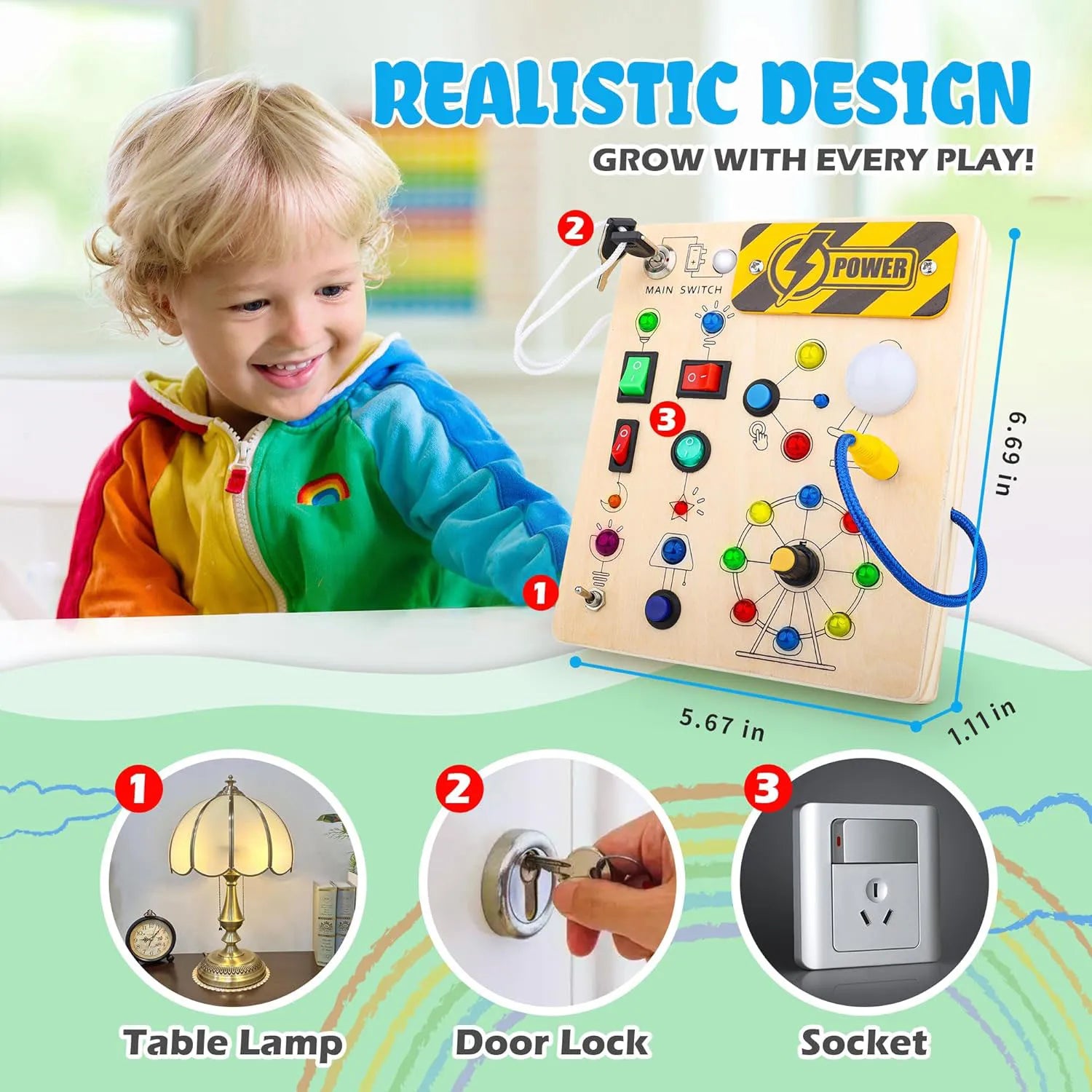
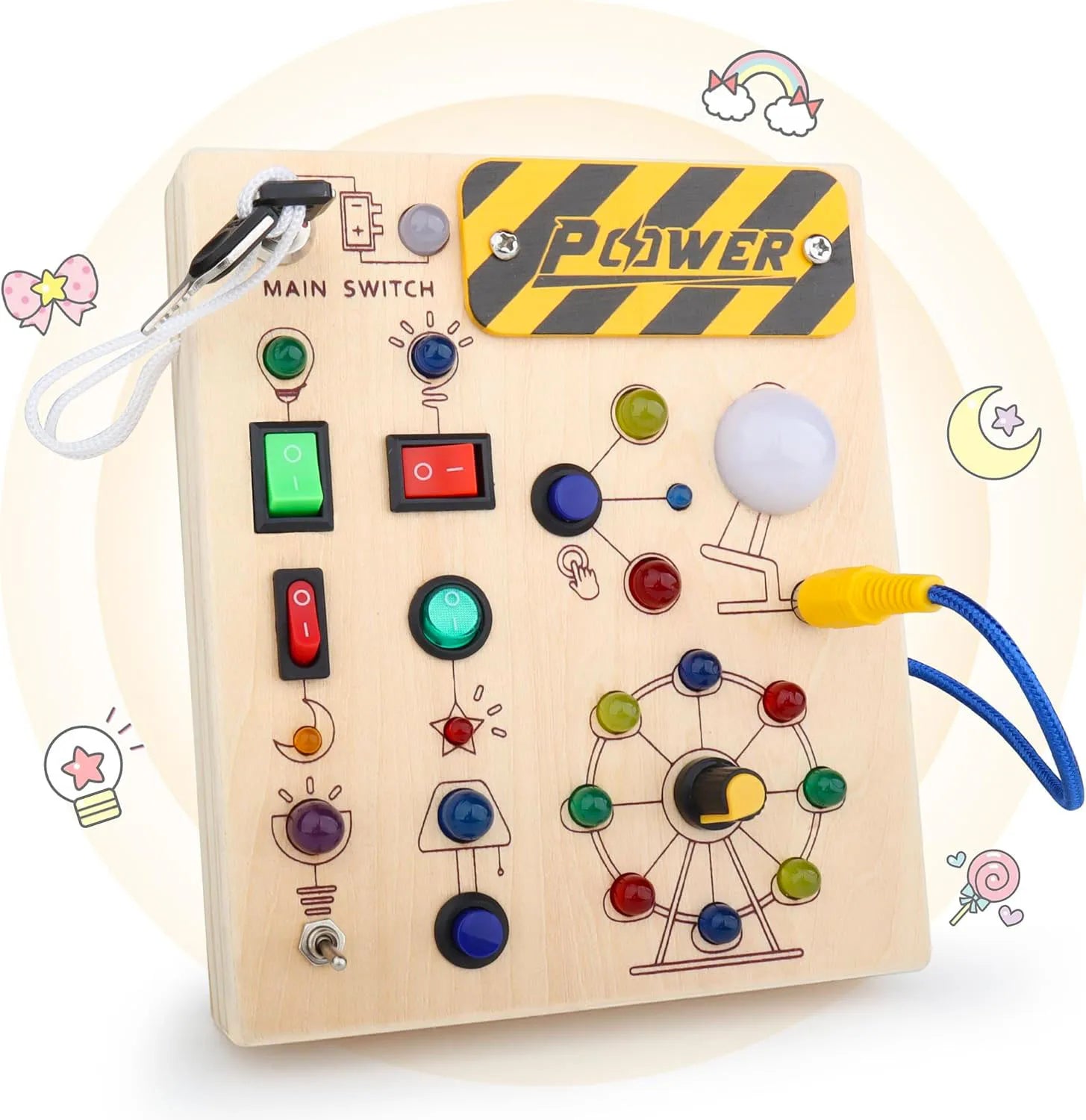
The Montessori Busy Board with LED Lights for Fun Learning provides another hands-on opportunity for children to explore switches, textures, and interactive components while developing coordination and sensory awareness.
Parents exploring sensory activities can browse Sensory Toys or find developmental resources in the Baby Growth & Learning Tips section.
Additional developmental tools are available through Mobility & Training and Smart Baby Gadgets collections.
Preparing the Learning Environment
A Montessori home environment should provide accessible materials, organized spaces, and enough time for uninterrupted exploration. The goal is to support independence rather than direct every action.
Common Mistakes When Introducing Sensorial Materials
Presenting Too Many Materials
Offering too many activities at once can overwhelm children. Montessori environments usually introduce materials gradually based on interest and readiness.
Skipping the Sequence
Children benefit from progressing from simple discrimination to more complex activities. Skipping foundational skills may reduce confidence and understanding.
Turning Lessons Into Quizzes
Sensorial work is about exploration, not testing. Adults should avoid repeatedly asking children to identify answers and instead allow discovery through experience.
Real Classroom Examples of Montessori Sensorial Learning
Observation Examples
In Montessori classrooms, teachers may observe children:
- Building the Pink Tower while carefully comparing cube sizes
- Matching Color Tablets and identifying shades
- Listening closely to Sound Cylinders
- Exploring textures through tactile materials
Typical Child Progression
Over time, children often move from simple matching activities toward complex classification, sequencing, and independent problem-solving. These experiences build concentration, confidence, and analytical thinking.
Conclusion
Montessori sensorial materials provide children with a powerful foundation for learning by transforming everyday sensory experiences into organized knowledge. Through carefully designed activities, children develop observation, classification, independence, and logical thinking skills.
Whether used in a Montessori classroom or at home, sensorial materials help children move from concrete experiences toward abstract understanding while preparing them for mathematics, language, and scientific exploration.
Parents can begin with simple sensory activities, carefully selected Montessori materials, and supportive learning resources from the Baby Care Tips & Advice section.
With the right environment and thoughtful guidance, Montessori sensory learning encourages curiosity, confidence, and lifelong learning habits.
Pillar Article: Best Preschool Educational Toys by Skill: Motor, Cognitive, Language & STEM (Ages 3–5)





