

Do STEM bath play activities really build skills in toddlers?
Yes — STEM bath activities for kids can build early problem-solving, observation, fine motor, language, and cause-and-effect skills while keeping learning playful. Simple bath time learning activities such as pouring, floating and sinking, measuring, and building water paths give toddlers immediate feedback they can see and feel. The goal is not formal lessons; it is letting children explore, predict, test, and try again through engaging water play activities for toddlers .
⏱ 12 min read
20 STEM Bath Play Activities for Kids: Fun Water Learning Ideas by Age
Turn ordinary bath time into playful discovery with STEM bath play activities that encourage children to pour, measure, observe, build, sort, and experiment. From simple DIY bath play ideas using household materials to educational bath toys that create water pathways, these activities support curiosity without making bath time feel like school. Explore 20 practical ideas for toddlers, preschoolers, and older kids, plus age-based guidance, safety tips, cleanup advice, and a simple activity-rotation system.
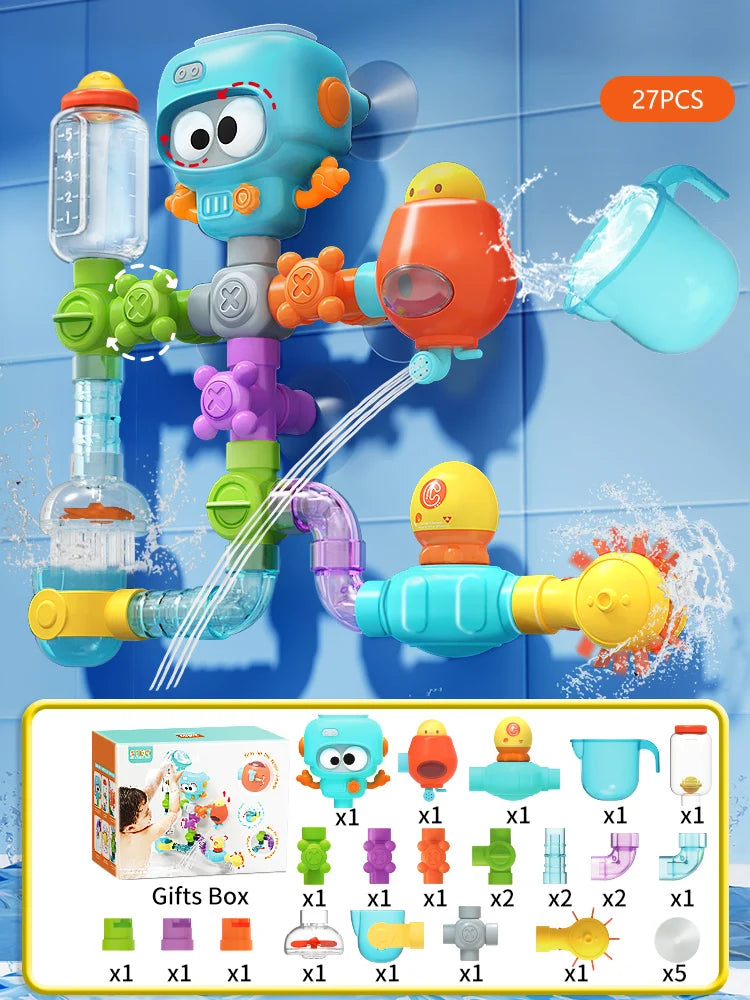
stem bath play activities, pipes bath toys — See it in action
Why water play is uniquely powerful for early STEM habits
Water is an unusually effective learning material because children can immediately see the results of their actions. Pour water into a cup and the level rises. Tilt a container and the water moves. Change the angle of a pipe and the flow changes. Drop an object into the tub and it may float or sink. These simple experiences create natural opportunities for children to observe, predict, test, and revise their ideas.
That makes water STEM activities at home especially useful for young children. A toddler does not need a formal science lesson to begin thinking like a problem-solver. When a child asks, "Where did the water go?" or tries a different angle after a pipe stops flowing, they are practicing early reasoning through play.
Common parenting pain points this solves
- Boredom: Rotating simple activities can make familiar bath routines feel new without buying a new toy every week.
- Short attention spans: Water provides immediate visual and tactile feedback, making it easy to create short experiments with a clear beginning and end.
- Resistance to bath time: Giving children a small choice, such as "Do you want to pour or build?" can make the routine feel more engaging.
- Messy sensory play: The bathtub provides a contained setting for many sensory bath activities that might otherwise spill across the floor.
- Passive toy use: Open-ended materials encourage children to manipulate, combine, and test instead of simply watching a toy perform.
Learning benefits of bath water play
- Cause and effect: Children discover that actions produce predictable results, such as squeezing, pouring, blocking, or redirecting water.
- Fine motor development: Scooping, squeezing sponges, transferring water, and connecting larger pieces require controlled hand movements.
- Early math: Counting scoops, comparing full and empty containers, and noticing more versus less introduce basic mathematical concepts.
- Language development: Words such as full, empty, heavy, light, fast, slow, floating, sinking, wet, and dry give children useful vocabulary.
- Observation and problem-solving: Children can make predictions, notice what happened, and change their approach.
- Sensory exploration: Water temperature, texture, movement, and pressure provide varied sensory experiences in a familiar environment.
- Curiosity: Open-ended questions encourage children to wonder about what will happen next rather than simply following instructions.
To understand how to make bath time educational , focus less on teaching a fixed answer and more on creating opportunities for exploration. A playful question such as "What do you think will happen?" is often more valuable than explaining the answer immediately.
What to use: DIY water play ideas, educational bath toys, and sensory materials
You do not need an expensive collection to create engaging DIY bath play ideas . Start with a few durable, washable materials and rotate them so each bath feels slightly different. Choose items that are large enough to avoid choking risks, easy to clean, and appropriate for your child's age.
Low-cost household materials
- Plastic cups: Use for pouring, filling, comparing volume, and counting scoops.
- Small funnels: Explore flow direction and practice controlled pouring.
- Washable containers: Compare sizes, capacities, and floating behavior.
- Clean sponges: Squeeze, absorb, transfer, and observe how water moves.
- Ice cubes: Explore cold versus warm water and observe melting over time with close supervision.
- Large washable objects: Test which objects float or sink and encourage children to predict the result first.
- Measuring cups: Introduce simple counting and volume comparisons.
- Large sieves: Let children observe how water passes through while larger objects remain behind.
Educational bath toys for open-ended play
Educational bath toys can extend what children do with water rather than simply providing entertainment. Pipes, connectors, funnels, scoops, and water wheels can help children create pathways, change flow, and repeat experiments. The best options are those that can be used in multiple ways as a child's interests and skills develop.
For a ready-made starting point, the DIY water pipe bath toy set can be incorporated into activities involving water flow, sequencing, and simple construction. Use it as one component of a broader play routine rather than relying on one toy for every session.
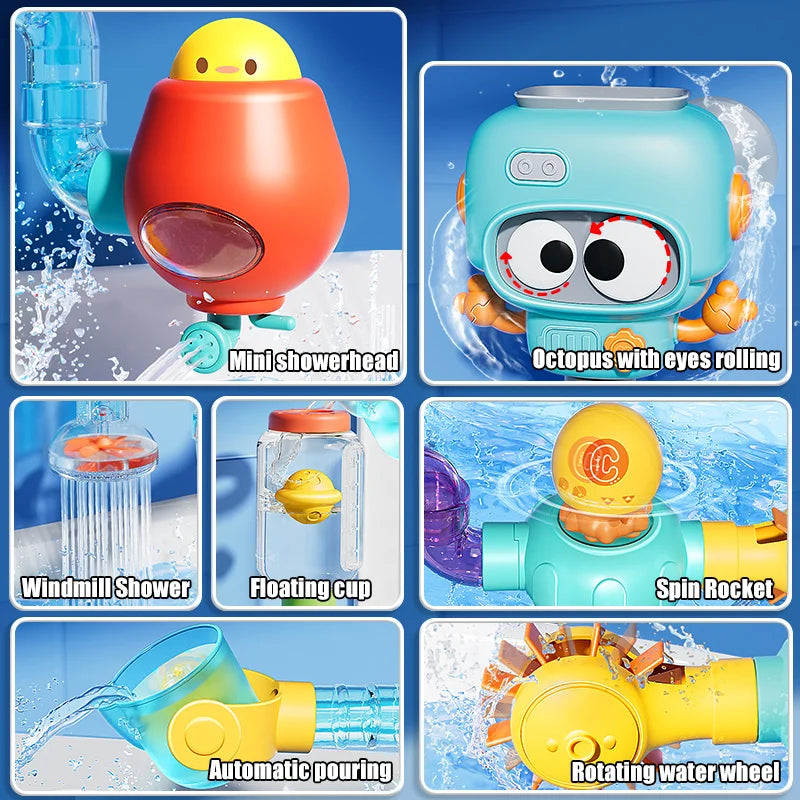
pipes bath toys, diy water play ideas — See it in action
20 bath water play activities for kids
These bath water play activities for kids are designed to be flexible. Most take only a few minutes to prepare, and many can be adapted for toddlers, preschoolers, and older children. Keep the activity playful, follow your child's interest, and stop when attention starts to fade.
Sensory bath activities
1. Sponge Squeeze Transfer
Materials: Two large containers and one clean bath sponge. Setup: 1 minute. How to play: Fill one container and invite the child to soak the sponge, carry it over, and squeeze the water into the empty container. Best for: Toddlers 18 months and up with close supervision. Learning benefit: Builds hand strength, coordination, concentration, and understanding of absorption and transfer.
2. Warm-and-Cool Water Discovery
Materials: Two containers with comfortably warm and slightly cooler water prepared by an adult. Setup: 2 minutes. How to play: Let children compare the containers by touch and describe how each feels. Best for: Toddlers and preschoolers. Learning benefit: Encourages sensory awareness and descriptive language. Always check water temperature yourself and avoid extreme temperatures.
3. Ice Cube Melt Watch
Materials: A few large ice cubes and a washable container. Setup: 1 minute. How to play: Ask children to predict what will happen to the ice and observe it as it melts. Best for: Preschoolers and older children. Learning benefit: Introduces observation, temperature, change of state, and time.
4. Texture and Texture-Free Water
Materials: Water-safe large sponges and smooth washable containers. Setup: 1 minute. How to play: Invite children to compare smooth, soft, wet, and saturated materials and describe what they notice. Best for: Toddlers and preschoolers. Learning benefit: Supports sensory vocabulary and tactile exploration.
STEM bath activities for kids
5. Build a Water Pipe Path
Materials: Large bath pipes and connectors designed for the child's age. Setup: 3–5 minutes. How to play: Build a simple path and pour water through it. Then change one piece and ask whether the water will still reach the end. Best for: Toddlers with adult help; preschoolers can build more independently. Learning benefit: Encourages sequencing, spatial reasoning, prediction, and early engineering thinking.
6. Float or Sink Prediction Game
Materials: Three to five large, safe, water-resistant objects. Setup: 2 minutes. How to play: Before placing each object in water, ask the child to predict whether it will float or sink. Test the prediction and discuss the result. Best for: Toddlers and preschoolers; older children can compare materials and weight. Learning benefit: Develops observation, classification, prediction, and early scientific reasoning.
7. The Fast-and-Slow Pour Experiment
Materials: One cup and one funnel or container with a larger opening. Setup: 1 minute. How to play: Try pouring slowly and quickly. Ask what changes and where the water goes. Best for: Toddlers and preschoolers. Learning benefit: Builds control, cause-and-effect understanding, and descriptive vocabulary.
8. Block the Flow
Materials: Large bath-safe pipes or channels and a removable stopper that is too large to swallow. Setup: 3 minutes. How to play: Let children observe what happens when the path is open, partially blocked, or redirected. Best for: Preschoolers and older children. Learning benefit: Introduces flow, obstruction, prediction, and problem-solving.
9. Water Wheel Investigation
Materials: A large, age-appropriate water wheel toy. Setup: 1 minute. How to play: Pour water from different heights or directions and observe how the wheel responds. Best for: Toddlers and preschoolers. Learning benefit: Demonstrates how moving water can create movement and encourages experimentation.
Color, counting, and alphabet games
10. Color Sorting Cups
Materials: Large washable cups or containers in different colors. Setup: 2 minutes. How to play: Ask children to sort objects by color or find matching containers. Best for: Toddlers and preschoolers. Learning benefit: Reinforces color recognition, matching, sorting, and early classification.
11. Count the Scoops
Materials: A scoop and large cup. Setup: 1 minute. How to play: Count each scoop as the child fills a container. Compare how many scoops different containers require. Best for: Toddlers and preschoolers. Learning benefit: Builds counting, one-to-one correspondence, and early quantity awareness.
12. Letter Wash Game
Materials: Large waterproof letters or washable letter cards designed for water use. Setup: 2 minutes. How to play: Call out a letter and ask the child to find it, or match a letter to a familiar word. Best for: Preschoolers and older children. Learning benefit: Supports letter recognition, listening, and early literacy in a playful setting.
13. Full, Half, and Empty
Materials: Three washable containers of different sizes. Setup: 1 minute. How to play: Fill containers to different levels and ask which has more, less, or the same amount. Best for: Toddlers and preschoolers. Learning benefit: Introduces comparison, quantity, and basic measurement language.
Fine motor and pouring activities
14. Funnel Filling Challenge
Materials: A large funnel and container. Setup: 1 minute. How to play: Ask children to pour enough water through the funnel to fill the container without overflowing. Best for: Toddlers with help; preschoolers can experiment with speed. Learning benefit: Improves hand-eye coordination, controlled movement, and awareness of volume.
15. Sponge-to-Cup Relay
Materials: One sponge and two containers. Setup: 1 minute. How to play: Move water from one container to another using only the sponge. Best for: Toddlers and preschoolers. Learning benefit: Strengthens grasping and squeezing skills while introducing transfer and absorption.
16. Make a Mini Rainstorm
Materials: A large plastic cup or container with several large drainage holes prepared by an adult. Setup: 2 minutes. How to play: Fill the container and lift it to create a gentle "rain." Ask children to notice how the water falls and what happens when the container is tilted. Best for: Toddlers and preschoolers. Learning benefit: Encourages observation, pouring control, and imaginative language.
Pretend play and imaginative bath games
17. Wash the Toy Rescue Station
Materials: A few large, washable bath-safe toys, cups, and a sponge. Setup: 2 minutes. How to play: Pretend the toys need to be cleaned and create a simple wash, rinse, and dry sequence. Best for: Toddlers and preschoolers. Learning benefit: Encourages sequencing, pretend play, vocabulary, and practical routines.
18. Bath-Time Car Wash
Materials: Large washable toy vehicles, a sponge, and a cup. Setup: 2 minutes. How to play: Create a pretend car wash using a sponge for scrubbing and a cup for rinsing. Best for: Toddlers and preschoolers. Learning benefit: Supports imaginative play, fine motor control, and action sequencing.
Seasonal and themed water play ideas
19. Under-the-Sea Sorting Adventure
Materials: Large ocean-themed bath-safe toys or washable objects. Setup: 2 minutes. How to play: Sort objects into groups such as animals, colors, or sizes, then invent a simple underwater story. Best for: Toddlers through early elementary ages. Learning benefit: Combines classification, language, storytelling, and imaginative play.
20. Weather Lab
Materials: Cups, a funnel, a large container, and ice cubes if appropriate. Setup: 3 minutes. How to play: Pretend to create rain, clouds, or melting snow while talking about what happens to water. Older children can sequence the water cycle using simple terms. Best for: Preschoolers and older kids. Learning benefit: Connects sensory play with weather concepts, observation, vocabulary, and early science.
How to run short, skill-building bath sessions
The most effective bath time learning activities do not need to take the entire bath. A simple 10-minute routine can provide enough time for a child to explore one idea without becoming overwhelmed.
A simple 10-minute activity routine
- Prepare for 1–2 minutes. Choose one activity and gather only the materials you need.
- Introduce one idea. Use a simple prompt such as "Let's see what happens when we pour slowly."
- Explore for 5–6 minutes. Let the child take the lead. Avoid correcting every attempt.
- Ask one prediction question. Try "What do you think will happen if we move this?"
- Repeat or change one variable. Pour faster, use a different container, or change the pipe arrangement.
- Clean up for 1–2 minutes. Rinse materials, empty trapped water, and place everything where it can dry fully.
Rotating activities is usually better than putting every toy in the tub at once. One evening might focus on pouring; another can explore floating and sinking. This keeps familiar materials interesting while reducing clutter and cleanup.
How to adapt activities by age
- Toddlers: Keep activities simple and sensory. Focus on scooping, pouring, squeezing, sorting, and basic float-or-sink experiments. Use larger materials and provide close adult supervision.
- Preschoolers: Add predictions, comparisons, counting, simple construction, and "what if" questions. Let children change one part of an experiment at a time.
- Older kids: Increase the challenge by asking them to design a water pathway, measure quantities, record observations, compare variables, or explain why an outcome changed.
Compare bath water play activities by age, skills, and setup time
Use this quick guide to choose fun bath activities for preschoolers , simple bath toy ideas for toddlers , or more challenging STEM bath activities for kids based on the time and materials you have available.
| Activity type | Best age | Primary skills | Setup time | Mess level | Materials |
|---|---|---|---|---|---|
| Sponge transfer | Toddlers | Fine motor, coordination, sensory exploration | 1 minute | Low | Sponge, 2 containers |
| Float or sink | Toddlers–preschoolers | Prediction, observation, classification | 2 minutes | Low | Large safe objects |
| Color sorting | Toddlers–preschoolers | Matching, sorting, early math | 2 minutes | Low | Large washable containers or objects |
| Pipe pathway | Preschoolers+ | Engineering, sequencing, spatial reasoning | 3–5 minutes | Low–medium | Large pipes and connectors |
| Funnel challenge | Toddlers–preschoolers | Pouring, hand-eye coordination, volume | 1 minute | Low | Funnel, cup, container |
| Weather lab | Preschoolers–older kids | Science, observation, language | 3 minutes | Low–medium | Cups, funnel, container, optional ice |
| Letter wash game | Preschoolers+ | Early literacy, recognition, listening | 2 minutes | Low | Large waterproof letters |
Pros and cons at a glance
- Pros: Most activities use inexpensive materials, can be completed in short sessions, adapt easily across ages, and naturally combine sensory exploration with early STEM, language, math, or motor practice.
- Cons: Active supervision is essential, some materials require frequent cleaning and thorough drying, and activities involving multiple pieces may take extra preparation.
Safety, supervision, and cleaning: keep bath play simple and consistent
Safe bath activities for kids should always prioritize supervision over learning goals. Water play is valuable, but no activity is worth leaving a child unattended. Keep your attention on the child throughout the bath and use only materials that are appropriate for their developmental stage.
Bath water safety basics
- Stay within immediate reach. Never leave a young child alone in or near bath water, even for a short task.
- Check water temperature yourself. Use comfortably warm water and test it before the child enters the bath. A thermometer can provide an additional check.
- Prevent slips. Keep the tub floor as clear as practical and remove loose items that could create a slipping hazard.
- Avoid choking hazards. Children who still mouth objects should not have access to small parts, detachable components, or objects that can fit fully inside their mouths.
- Choose age-appropriate materials. Inspect toys and household items for sharp edges, cracks, loose pieces, or materials that are not intended for water use.
- Keep activity quantities manageable. A few materials are usually enough. Too many objects can increase clutter and make supervision harder.
How to clean and store bath activity materials
- Rinse reusable materials after each bath to remove soap residue and debris.
- Empty water completely from hollow toys, pipes, and containers whenever possible.
- Allow items to dry fully in an area with good airflow before storing them.
- Clean sponges regularly and replace them if they develop an odor, discoloration, or visible buildup.
- Follow the manufacturer's cleaning instructions for specialty educational bath toys.
- Periodically inspect reusable materials and discard damaged items that cannot be cleaned effectively.
For easier cleanup, keep a small drying basket or open container near the tub. Separate pieces so air can circulate instead of storing wet items in a closed bag or sealed bin. This simple habit can reduce caregiver workload and help activity materials stay fresher between uses.
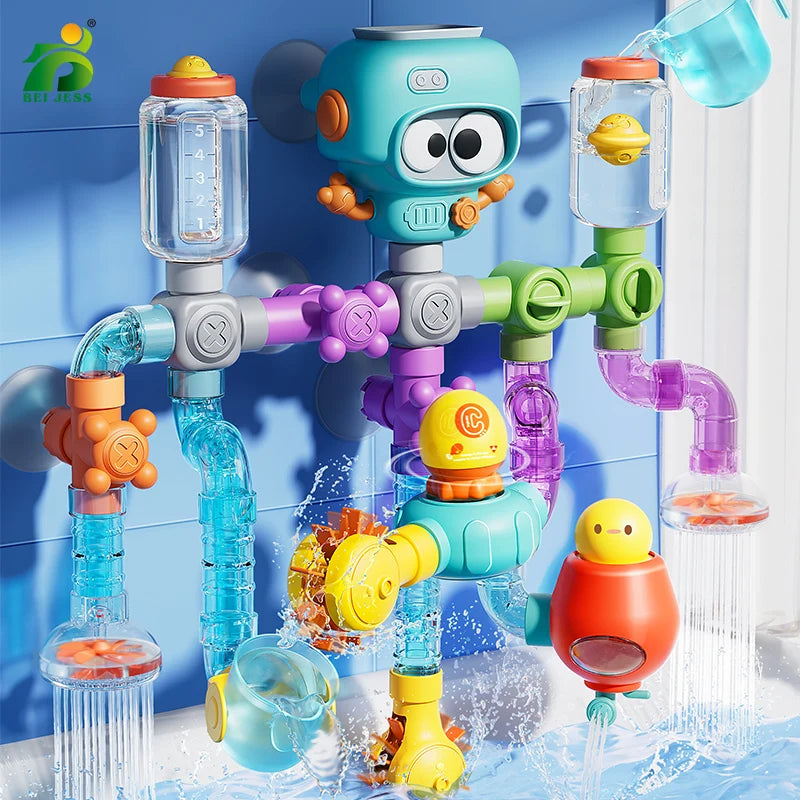
sensory tub activities, diy water play ideas — See it in action
Why a focused water-play setup beats random toys
A tub filled with random toys can be entertaining, but a small, intentional collection makes it easier to create meaningful play. The goal is not to own more educational bath toys . It is to have a few versatile materials that can support many different challenges.
For example, one cup can support counting, pouring, volume comparisons, pretend play, and float-or-sink experiments. A funnel can be used for controlled pouring, flow experiments, and water pathways. Pipes can be connected in different arrangements to encourage children to test, adjust, and try again.
How to rotate bath activities without overbuying
- Keep three core categories: pouring and transferring, building and redirecting, and sorting or experimenting.
- Change one variable: Use the same materials but change the question, container, water level, or arrangement.
- Offer limited choices: Present two activities rather than the entire collection.
- Follow interests: If a child enjoys vehicles, create a car wash. If they like construction, build a pipe path.
- Retire and reintroduce: Put some materials away for a week or two, then bring them back with a new challenge.
Quick cheat-sheet: what to keep in your bath learning kit
- ☐ 2–4 large plastic cups or washable containers
- ☐ 1–2 funnels
- ☐ 1 clean sponge
- ☐ 1 scoop or measuring cup
- ☐ 1 large sieve or water-safe strainer
- ☐ 3–5 large objects for float-and-sink experiments
- ☐ Optional large pipes and connectors for water pathways
- ☐ Optional waterproof letters or numbers for preschool learning
- ☐ Open drying basket or caddy for airflow
Related helpful resources
- Sensory play activities for toddlers — ideas for extending hands-on exploration beyond bath time.
- Educational bath toys — learn which features can make bath play more engaging and developmentally useful.
- Fun bath toys for kids — explore practical bath-time options and accessories.
- Toddler learning activities — discover more ways to support curiosity and early development through play.
Printable-style activity rotation checklist
- ☐ Monday: Pouring or transferring activity
- ☐ Tuesday: Float-or-sink experiment
- ☐ Wednesday: Building or water-flow challenge
- ☐ Thursday: Counting, sorting, or color activity
- ☐ Friday: Pretend-play theme
- ☐ Weekend: Child chooses a favorite activity or invents a new variation
Mini FAQ
-
How can I make bath time educational for my child?
Choose one simple concept at a time, such as pouring, counting, floating and sinking, or water flow. Ask open-ended questions, let your child experiment, and describe what you both observe. The best bath water play activities for kids feel like play first and learning second.
-
What are the best water play activities for toddlers?
Simple activities such as sponge squeezing, cup pouring, scooping, color sorting, and basic float-or-sink games work well for toddlers. Use large, age-appropriate materials and keep the activity short enough to match the child's attention span.
-
What are some easy STEM bath activities for kids?
Try building a water pipe path, predicting whether objects will float or sink, comparing full and empty containers, testing fast versus slow pouring, or changing the direction of water flow. These STEM bath activities for kids encourage children to predict, test, observe, and try again.
-
How long should a bath water play activity last?
There is no required duration. For toddlers, 5–10 focused minutes may be enough, while preschoolers and older children may stay engaged for 10–20 minutes. Follow the child's interest and end the activity when attention or enjoyment drops.
-
What household items are safe for DIY bath play?
Large plastic cups, washable containers, clean sponges, funnels, scoops, and age-appropriate strainers can work well when they are in good condition and used under supervision. Avoid sharp, breakable, toxic, or small objects that create choking hazards. Always consider whether a material is suitable for repeated contact with bath water.
-
How do I keep bath toys and activity materials clean?
Rinse items after use, empty trapped water, and allow everything to dry completely with good airflow. Clean materials according to their care instructions and regularly inspect them for buildup, mold, damage, or odors. Replace items that cannot be cleaned effectively.
Pillar Article: Bath Toys for Toddlers Benefits: Why These Features Matter Most
Other Related Articles:
Explore More:





