

What Is Hands-On Learning? Benefits, Examples & How It Works
What is hands on learning: How to apply it in preschool math
⏱ 7 min read
Hands-on learning gives preschoolers opportunities to learn by doing rather than only listening, watching, or memorizing. In early math, children can touch, move, sort, count, compare, and build with real objects, making abstract ideas easier to explore. From household items to preschool manipulatives toys, hands-on experiences can support number sense, problem-solving, coordination, independence, and confidence.
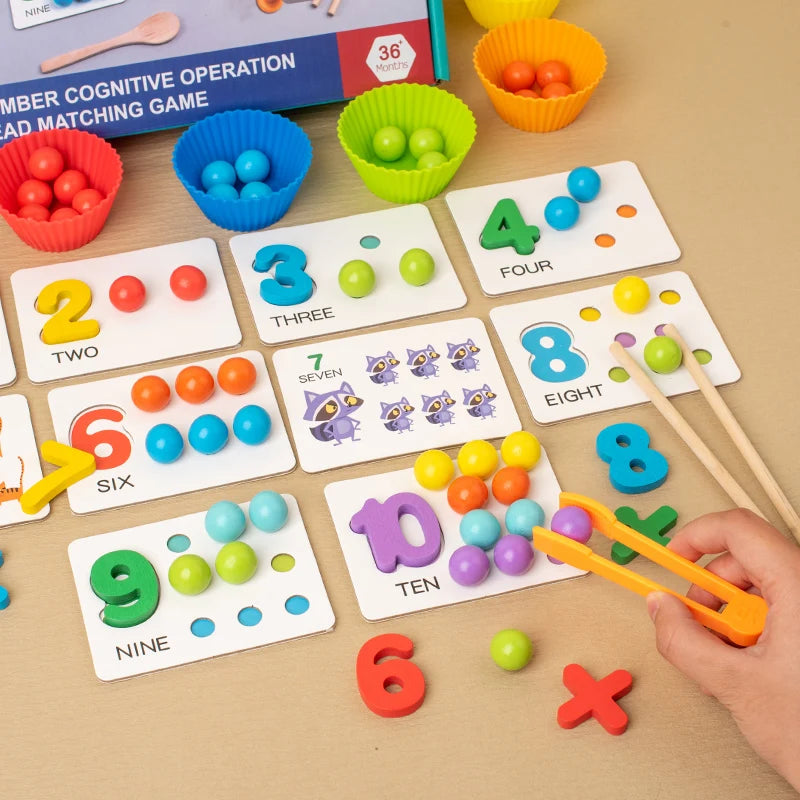
See it in action - what is hands on learning / hands on learning benefits, preschool math learning, and visual aids for math
What Is Hands-On Learning? Definition and Key Idea
What is hands on learning? It is an approach in which children actively participate in an activity by handling materials, testing ideas, making choices, and observing what happens. Instead of receiving information passively, the child interacts with something concrete and uses that experience to develop an understanding of a concept.
For preschoolers, this can be as simple as counting blocks, arranging objects by size, matching shapes, measuring ingredients, or building a structure. The physical activity is not the entire lesson; it gives children a concrete experience that an adult can connect to language, questions, and later symbols.
Passive instruction might ask a child to look at the number 4 and repeat its name. A hands-on activity could ask the child to place four blocks on a table, count each block, and then connect the group to the written numeral 4. The child is still learning the same mathematical idea, but the concept has a physical reference.
This is one reason why hands on learning is important in preschool: young children are still developing the ability to reason about ideas that have no visible or physical representation. Concrete experiences can give them something meaningful to observe and discuss before they move toward more abstract forms of learning.
How Does Hands-On Learning Work?
Hands-on learning works by connecting an active experience with a concept, language, practice, and reflection. A useful sequence is to let the child explore first, manipulate and practice a skill, and then explain or apply what was discovered.
Explore
Begin with an opportunity to investigate. Give the child safe, age-appropriate materials and a simple goal without immediately showing exactly what to do. For example, provide several shapes and ask, “What can you find that is the same?”
Exploration gives children time to notice differences, similarities, quantities, textures, positions, and patterns. Adults can observe what the child already understands before deciding how much guidance is needed.
Manipulate and Practice
Next, let the child physically change or organize the materials. They might group objects, count them, arrange them from smallest to largest, or combine two groups. Repeating the action with small variations gives children opportunities to practice while receiving immediate information from what they see and do.
For example, if a child builds a group of three blocks and adds one more, the new group provides a concrete way to explore the idea of four. The adult can ask questions rather than simply provide the answer.
Reflect and Apply
Finish by connecting the activity to words, pictures, symbols, or another situation. Ask questions such as, “How many are there now?” or “How did you know these shapes matched?” Then invite the child to use the same idea somewhere else.
This progression helps connect concrete experiences to increasingly abstract concepts. Repetition matters, but it is more useful when children are actively practicing a skill and receiving appropriate feedback rather than simply repeating an answer.
Hands-On Learning Benefits for Preschool Children
The hands on learning benefits come from the quality of the interaction, not simply from touching a toy or completing an activity. When an activity has a clear purpose and gives children opportunities to make decisions, several areas of early learning can be supported.
- Engagement and attention: Manipulating materials gives children an active role, which can make a learning task easier to participate in.
- Understanding and retention: Concrete experiences give children something they can see and revisit when connecting an idea to words or symbols.
- Problem-solving: Open-ended materials allow children to test possibilities, notice outcomes, and adjust their approach.
- Critical thinking: Sorting, comparing, predicting, and explaining encourage children to look for relationships rather than only recall answers.
- Coordination: Picking up, placing, stacking, threading, and arranging materials can provide opportunities to practice controlled hand movements.
- Independence: Children can make choices about how to approach a task and gradually take more responsibility for completing it.
- Confidence: When children can experiment and try again, mistakes can become part of the learning process rather than an immediate reason to stop.
These benefits are strongest when adults match the activity to the child's developmental level and give enough guidance to support learning without taking control of the task.
Hands-On Learning in Preschool Math
Hands on learning in preschool math helps children connect quantities, shapes, relationships, and measurement ideas with physical materials. Manipulatives and other visual aids for math can represent concepts that are difficult for a young child to understand from numbers or verbal explanations alone.
Counting and Number Sense
Use blocks, buttons, toy animals, beads, or wooden numbers to practice one-to-one counting. Ask the child to touch or move one object for each number spoken. Then connect the quantity to a written numeral.
You can extend the activity by asking which group has more, which has fewer, or what happens when one object is added or removed. The physical groups make quantities visible while the child develops early number sense.
Shapes, Patterns, and Sorting
Give children objects with different shapes, colors, sizes, or textures and ask them to sort them in different ways. For patterns, start with simple sequences such as red-blue-red-blue and let the child continue the pattern.
These preschool math activities encourage children to compare attributes and recognize relationships. Once a child can physically arrange objects, an adult can represent the same relationship with drawings or simple symbols.
Addition, Subtraction, and Measurement
Concrete objects can also introduce early operations and measurement. Combine two small groups of blocks to explore addition, remove objects to model subtraction, or compare the lengths of household objects using a nonstandard unit such as blocks.
A useful progression is concrete → visual → symbolic . First, let children manipulate objects. Next, represent the experience with drawings, pictures, or another visual model. Finally, introduce numbers or symbols when the child is ready to connect them with the underlying idea.
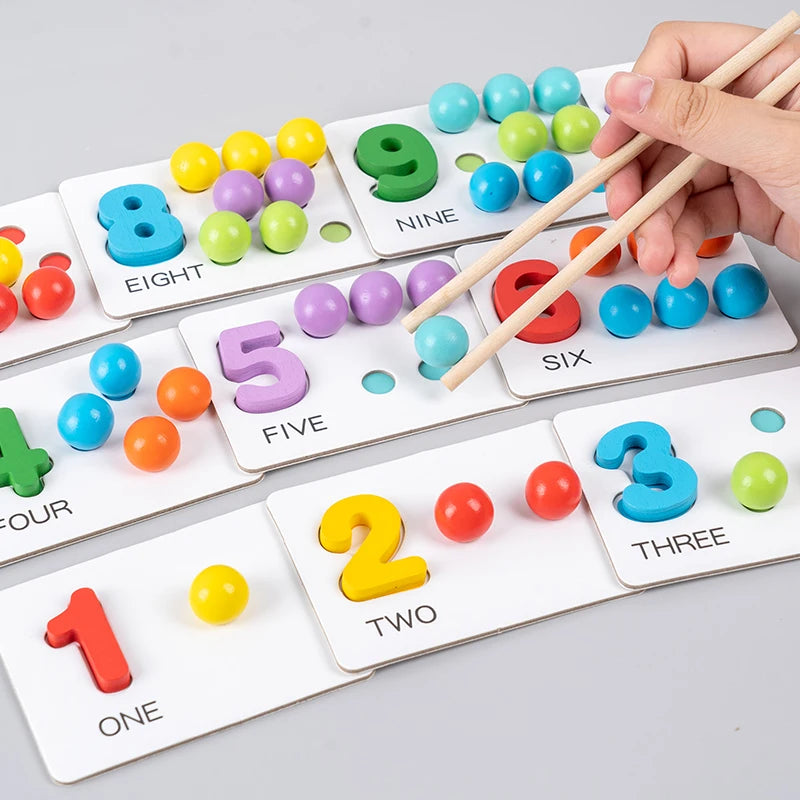
See it in action - hands-on preschool math activities using concrete materials and visual aids for math
A children math teaching aids Montessori wooden set can be one option for structured counting, sorting, matching, and early math practice. The important factor is not the specific material but whether the material helps the child investigate the learning goal rather than becoming a distraction.
Examples of Hands-On Learning by Age and Subject
There are many examples of hands on learning beyond preschool math. The same basic idea can be adapted to different subjects by giving children something concrete to investigate and a skill or concept to practice.
Preschool Math
Activity: Sort household objects by color, size, or shape, then count each group.
Skill developed: Classification, counting, comparison, and early number sense.
Science and STEM
Activity: Build a simple structure with blocks and test which shapes or arrangements make it more stable. For a nature activity, collect leaves and compare their sizes, shapes, or textures.
Skill developed: Observation, prediction, experimentation, comparison, and early problem-solving.
Language and Literacy
Activity: Use letter cards or magnetic letters to build a familiar word, then ask the child to identify or rearrange the letters.
Skill developed: Letter recognition, sequencing, vocabulary, and early phonological awareness.
Art and Everyday Life
Activity: Let children mix colors, measure ingredients with adult supervision, organize objects, or create a collage from different materials.
Skill developed: Fine-motor coordination, sequencing, observation, independence, and practical problem-solving.
These preschool hands on learning activities can happen at home or in a classroom. Everyday materials can be enough; the adult's questions and the child's active participation often matter more than having specialized equipment.
Hands-On Learning vs. Traditional, Passive, and Related Approaches
Hands-on learning overlaps with several other educational approaches, but the terms are not interchangeable. Understanding the differences helps parents and educators choose an activity for a specific purpose.
Hands-On vs. Passive Learning
Passive learning generally places the child in the role of receiving information through listening, watching, or repeating. Hands-on learning gives the child an active role in manipulating materials, making observations, testing ideas, or solving a problem.
This does not mean passive instruction is always inappropriate. A short explanation or demonstration can provide useful information before a child tries an activity independently.
Hands-On vs. Experiential Learning
Experiential learning emphasizes learning through experience and the process of reflecting on that experience. Hands-on learning often provides the physical activity within that broader process. For example, measuring ingredients is hands-on; discussing what happened, comparing measurements, and applying the idea to another recipe adds an experiential learning component.
Hands-On vs. Project-Based and Play-Based Learning
Project-based learning typically involves sustained investigation toward a larger outcome, while play-based learning uses play as a central context for development and learning. Both can include hands-on activities.
Hands-on learning is therefore best understood as a way of engaging with materials and ideas rather than as a single curriculum or teaching method. A preschool project, game, practical task, or play activity can all include hands-on learning when children actively participate in the experience.
How to Teach Preschool Math With Hands-On Activities
When learning how to teach preschool math, start with one clearly defined skill instead of trying to teach several concepts at once. Then choose materials that make that particular idea visible and allow the child to participate.
Choose One Learning Goal
Decide what the child should practice. For example, the goal might be counting objects to 10, identifying basic shapes, comparing quantities, or extending a simple pattern.
Start With Concrete Materials
Use whatever safe materials fit the goal: blocks, buttons, cups, paper shapes, toy animals, craft materials, or wooden manipulatives. Begin with a small number of objects so the activity remains manageable.
Add Visuals and Questions
Once the child is manipulating the materials, introduce drawings, pictures, numerals, or other visual representations. Ask open questions such as “What do you notice?”, “How could we make these groups equal?” or “What do you think will happen if we add one more?”
Move Toward Independent Practice
Reduce your assistance as the child becomes more comfortable. Let the child choose materials, demonstrate the process, explain an answer, or create a new example. If the child makes an error, ask a question or provide a small clue before immediately correcting the answer.
For more ideas about learning through play , explore Baby Growth & Learning and Sensory Toys .
When Is Hands-On Learning Most Useful?
Hands-on learning is particularly useful when a concept is abstract, when a child needs repeated opportunities to practice, or when physical materials can make relationships easier to see. Early counting, sorting, patterning, shape recognition, and measurement are natural examples.
It can also be useful when a child needs more modeling before working independently. An adult can demonstrate one example, invite the child to copy or modify it, and then gradually step back.
Children do not all need the same amount of physical practice or the same type of support. Some may benefit from additional demonstrations, while others may be ready to move quickly from objects to drawings or symbols. A balanced preschool learning routine can combine hands-on activities with conversation, stories, observation, drawing, movement, and other forms of instruction.
Common Hands-On Learning Mistakes to Avoid
Hands-on activities are not automatically effective simply because children are using physical materials. The activity should still have a purpose and give the child an opportunity to think.
- Using activities without a learning objective: Decide what skill the activity is intended to practice before choosing the materials.
- Choosing materials that distract from the concept: Too many colors, pieces, sounds, or complicated rules can make it harder to focus on the intended skill.
- Doing too much for the child: Demonstrate when needed, but leave enough of the task for the child to explore and solve.
- Overcomplicating activities: A simple sorting or counting task can be more useful than a complicated activity with too many steps.
- Skipping discussion and reflection: Ask the child to describe what happened, compare results, or explain how they reached an answer.
The goal is not to replace every worksheet, explanation, or demonstration with a toy. Instead, use hands-on experiences strategically when physical interaction can help children understand and practice a concept.
FAQ About Hands-On Learning
What is hands-on learning in simple terms?
Answer: Hands-on learning means learning through active participation. Children use physical materials, perform actions, explore possibilities, and connect what they experience with a concept or skill.
Why is hands-on learning important?
Answer: Hands-on learning gives children concrete experiences they can connect to language, pictures, and symbols. It can support active participation, problem-solving, coordination, independence, and understanding when activities are matched to an appropriate learning goal.
What are examples of hands-on learning?
Answer: Examples include counting blocks, sorting objects, building structures, measuring ingredients, arranging patterns, mixing colors, investigating natural materials, and using letter cards to build words.
What are hands-on learning activities for preschoolers?
Answer: Preschool hands on learning activities can include sorting and counting household objects, building with blocks, matching shapes, extending patterns, measuring during supervised cooking, exploring textures, and creating simple art projects.
How does hands-on learning help with preschool math?
Answer: Hands-on learning in preschool math lets children use concrete objects to explore quantities, shapes, patterns, addition, subtraction, and measurement. Adults can then connect those physical experiences to pictures and mathematical symbols.
Pillar Article: Preschool number recognition activities: Step-by-step guide for parents
Other Related Articles:
- Preschool manipulatives toys: How to use them step by step
- Interactive math tools: How to use them for fast learning at home
- Hands on math activities for kindergarten: Easy daily routine guide
Explore More:





